Ellipse Arc Length Calculator
Measure any arc of an ellipse from its axes and angles, with every step shown.
Original Curve & Selected Arc
Gold dots mark the midpoint of each subinterval.
Integrand g(x) & Midpoint Rectangles
Hover a rectangle for its subinterval, midpoint, integrand value and contribution.
Detailed Midpoint Calculation Table
Convergence Comparison
Differences between successive refinements are a practical error indicator, not a guaranteed error bound.
Calculation Error
Section Navigation
How to Use the Ellipse Arc Length Calculator
The Ellipse Arc Length Calculator measures the length of an arc on an ellipse from its two semi-axes and two angles. The page opens with the Ellipse Arc Length panel active, showing the formula L = ∫θ1θ2 √(a2 sin2θ + b2 cos2θ) dθ. Follow these steps to get a correct answer in under a minute.
- Choose how the axes are entered. Use semi-axis lengths (a, b) by default. If you measured the full axes instead, switch to full-axis lengths and the calculator halves each value for you.
- Enter the semi-major axis (a). This is the longest radius of the ellipse, measured from the centre to the farthest point on the boundary.
- Enter the semi-minor axis (b). This is the shortest radius, measured from the centre to the nearest point on the boundary. It must not be larger than a.
- Enter the start angle (θ1) and end angle (θ2). Use the DEG and RAD toggle at the top of the panel to match your numbers. Degrees are the default.
- Pick an arc direction. Counterclockwise follows the angles upward from θ1 to θ2. Clockwise goes the other way. Shortest and longest compare both physical paths and report the shorter or longer one.
- Choose a unit and a precision. The unit labels the answer; the precision sets how many decimal places the result shows.
- Click Calculate Now. The calculator evaluates the arc-length integral numerically and shows the result, the full perimeter, the complementary arc, the percentage of the perimeter, and the coordinates of both endpoints.
- Copy or reset. Use Copy Result to place the answer on your clipboard, or Reset to clear the panel. The Swap Start and End Angles link exchanges θ1 and θ2 in one click.
Try an example. The Quarter Ellipse, Half Ellipse, Quarter Circle, and Complete Ellipse buttons load verified values instantly: a = 5, b = 3, from 0° to 90° gives 6.3817497158 units, and the same ellipse from 0° to 360° gives the full perimeter, 25.5269988634 units.
Important tips. Keep a and b in the same unit. Enter b no larger than a. Remember that the angles are parametric angles, measured from the centre, not angles measured along the boundary. If the start and end angles are equal, the arc length is zero; use 0° to 360° for a complete ellipse.
What Is an Ellipse Arc Length?
An ellipse is a closed curve formed by all points whose distances to two fixed points, the foci, add up to the same constant. It looks like a stretched circle: it has a long direction and a short direction, but it is perfectly smooth, with no corners. An arc is a portion of that curve between two points on it. The arc length is the distance you would travel if you walked along the curve from the first point to the second.
Every point on an ellipse can be described with a single angle θ, called the parametric angle:
Here a is the semi-major axis and b is the semi-minor axis. As θ runs from 0 to 2π radians, the point (x, y) traces the whole ellipse exactly once, starting at (a, 0) and returning there. An arc from θ1 to θ2 is the part of that trace between the two angles.
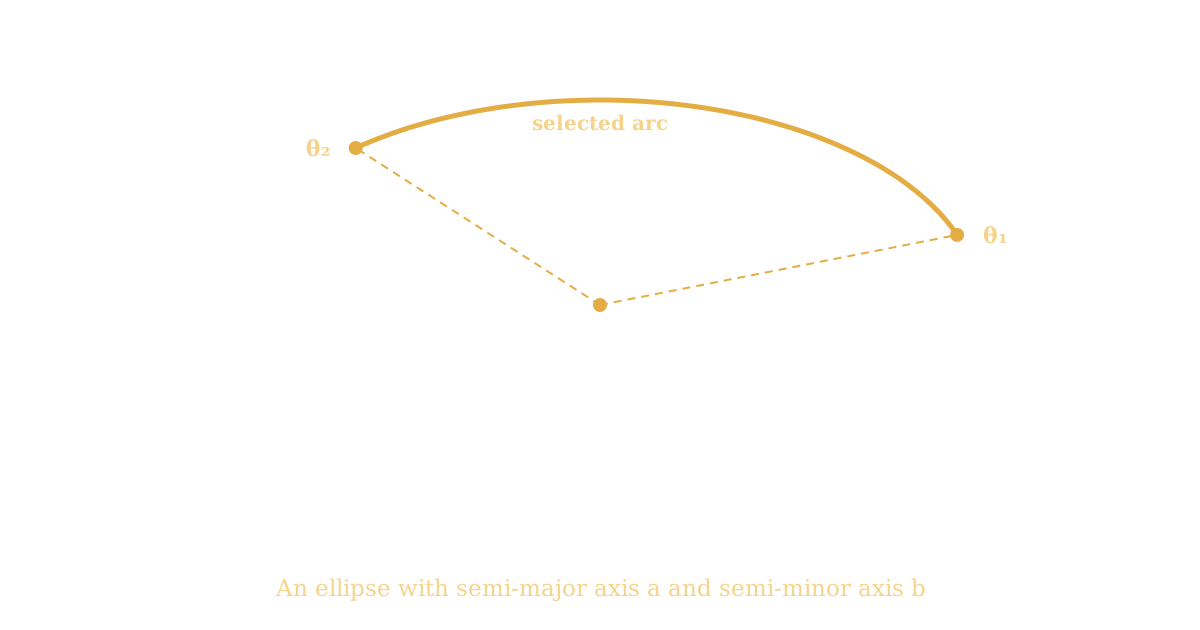
An elliptical arc differs from a circular arc in one important way. On a circle, every point is the same distance r from the centre, so the arc length is simply L = rθ. On an ellipse, the distance from the centre changes as you move around the curve, so the speed at which the curve is traced changes too. The arc length therefore depends on the shape of the ellipse, not just on the angle swept, and it must be found by integration rather than by a single multiplication.
That is why ellipse arc length is a genuine calculation and not a lookup. The calculator on this page performs that integration numerically, to high precision, for any ellipse and any pair of angles.
Ellipse Arc Length Formula
The arc length of an ellipse between parametric angles θ1 and θ2 is given by a definite integral:
Each symbol in the formula has a precise meaning:
| Symbol | Meaning | Notes |
|---|---|---|
| a | Semi-major axis | Longest radius; a > 0 and a ≥ b |
| b | Semi-minor axis | Shortest radius; b > 0 and b ≤ a |
| θ1 | Start angle | Parametric angle of the first endpoint |
| θ2 | End angle | Parametric angle of the second endpoint |
| θ | Parametric angle | Runs from θ1 to θ2 inside the integral |
| ds | Differential arc length | ds = √(a2 sin2θ + b2 cos2θ) dθ |
The integrand √(a2 sin2θ + b2 cos2θ) is the speed at which the point (a cos θ, b sin θ) moves as θ increases. It is smallest, equal to b, at θ = 0°, where the curve crosses the major axis, and largest, equal to a, at θ = 90°, where the curve crosses the minor axis. Integrating that speed over the angle interval adds up all the tiny segments into the total arc length.
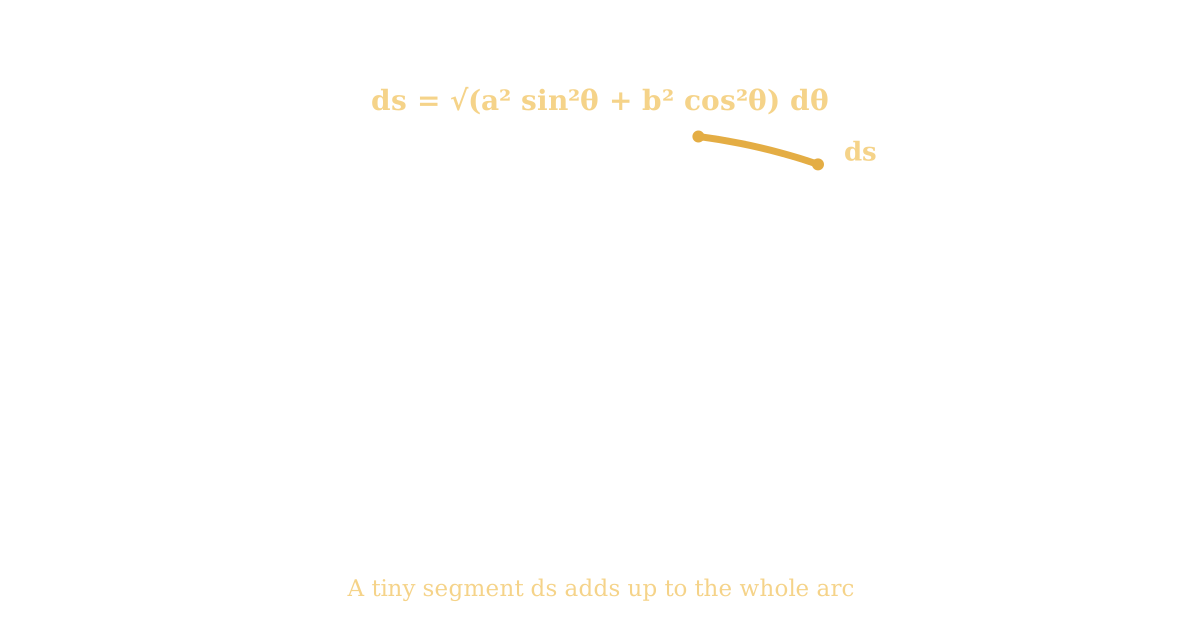
When a = b, the ellipse is a circle of radius r = a, the integrand becomes the constant r, and the formula collapses to the familiar L = rθ, with θ in radians. That special case is a useful check: any ellipse calculator must reproduce the circle result when the two axes are equal.
How to Calculate the Arc Length of an Ellipse
Calculating an ellipse arc length by hand follows eight steps. The worked example below uses a = 5, b = 3, from 0° to 90°, a quarter ellipse.
- Identify the semi-major axis. a = 5 units.
- Identify the semi-minor axis. b = 3 units.
- Determine the start angle. θ1 = 0°.
- Determine the end angle. θ2 = 90°.
- Convert degrees to radians when necessary. 0° = 0 radians and 90° = π/2 ≈ 1.5707963268 radians.
- Apply the ellipse arc length integral. L = ∫0π/2 √(25 sin2θ + 9 cos2θ) dθ.
- Evaluate the integral numerically. The integrand has no elementary antiderivative, so use a numerical method such as adaptive Simpson's rule, which refines its intervals until the answer is stable.
- Interpret the final answer. L ≈ 6.3817497158 units. The calculator on this page returns the same value.
To see why numerical integration is needed, look at the integrand at three angles:
A single Simpson step across the whole quarter gives (π/4)/3 × (3 + 4 × 4.1231056256 + 5) ≈ 6.4121012169, which is close but not exact. Adaptive Simpson's rule keeps splitting the interval and re-evaluating until the error falls below its tolerance, converging on 6.3817497158. The lesson is practical: a rough numerical estimate is easy, but a trustworthy answer needs a method that checks its own accuracy, which is what the calculator does.
Understanding the Semi-Major and Semi-Minor Axes
The major axis is the longest straight line through the centre of the ellipse, running from one side of the boundary to the other. The minor axis is the shortest such line, perpendicular to the major axis. The semi-major axis a is half the major axis: the distance from the centre to the boundary along the long direction. The semi-minor axis b is half the minor axis: the distance from the centre to the boundary along the short direction.
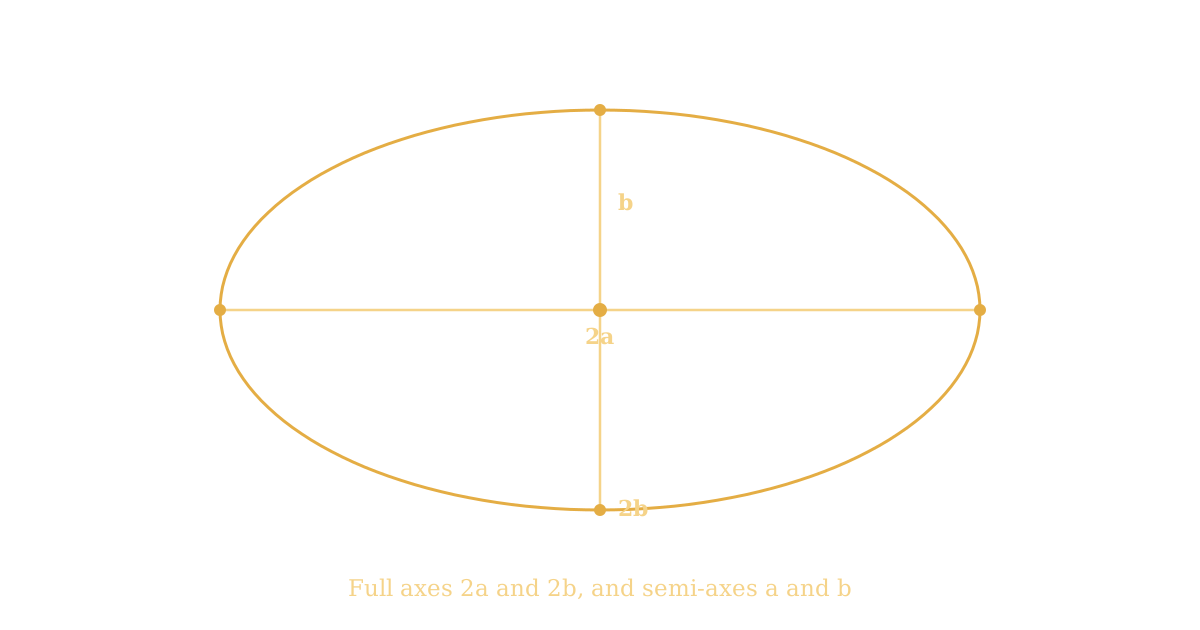
Confusing full axes with semi-axes is the most common input error. If a drawing gives the full width of an ellipse as 10, the semi-major axis is a = 5, not 10. Entering 10 as a would describe an ellipse twice as large, and every length the calculator returns would be doubled. The calculator offers a full-axis mode for exactly this situation: enter the full lengths, and it halves them before calculating.
The two axes also control the shape. When a and b are nearly equal, the ellipse is nearly a circle. When b is much smaller than a, the ellipse is long and flat, like a running track seen from the side. The ratio b/a is sometimes called the aspect ratio; the eccentricity e = √(1 − (b/a)2) measures the same idea, with e = 0 for a circle and e close to 1 for a very flat ellipse. For a = 5 and b = 3, e = √(1 − 9/25) = 0.8.
Complete Ellipse Perimeter vs Partial Arc Length
The complete perimeter is the length of the whole closed curve, while a partial arc length is the length of one piece of it. The perimeter is the special case of the arc formula with θ1 = 0° and θ2 = 360°:
The factor 4 appears because the four quadrants of an ellipse are mirror images of each other. For a = 5 and b = 3, the perimeter is P ≈ 25.5269988634 units. The table below compares the standard pieces of that ellipse.
| Arc | Angles | Length | Share of perimeter |
|---|---|---|---|
| Quarter ellipse | 0° to 90° | 6.3817497158 | 25% |
| Half ellipse | 0° to 180° | 12.7634994317 | 50% |
| Three-quarter ellipse | 0° to 270° | 19.1452491475 | 75% |
| Complete ellipse | 0° to 360° | 25.5269988634 | 100% |
A quarter ellipse is exactly one quarter of the perimeter, and a half ellipse exactly one half, because the quadrants are mirror images. But that symmetry only holds for arcs that start and end on the axes. An arbitrary 90° sweep is not one quarter of the perimeter: on the larger ellipse with a = 10 and b = 6, the arc from 30° to 120° measures 14.4818404027 units, exactly double the value for the a = 5, b = 3 ellipse, and the worked example later in this guide shows that this 90° sweep is 28.3657% of the larger ellipse's perimeter. Never assume a 90° sweep equals P/4 unless it runs from one axis to the next.
The calculator reports both numbers for every calculation: the arc length you asked for, and the complete perimeter it belongs to, together with the complementary arc (the rest of the ellipse) and the percentage of the perimeter your arc covers.
Exact Ellipse Arc Length vs Approximation
Ellipse arc length has no exact formula built from ordinary functions. The integral ∫ √(a2 sin2θ + b2 cos2θ) dθ is an incomplete elliptic integral of the second kind, written E(φ, k), where φ is the angle and k = √(1 − (b/a)2) is the eccentricity. The arc from θ1 to θ2 is a × (E(θ2, k) − E(θ1, k)). For a = 5 and b = 3, k = 0.8, and the quarter ellipse is 5 × E(π/2, 0.8) = 5 × 1.2763499432 = 6.3817497158.
Elliptic integrals are well understood, but they are not elementary: no combination of polynomials, roots, exponentials, and trigonometric functions evaluates them in closed form. That is why every practical ellipse calculation uses numerical integration. Adaptive Simpson's rule, which this calculator uses, is a good choice because it refines the intervals where the integrand changes fastest and stops when the result is stable to within its tolerance.
For the complete perimeter only, there is also a famous approximation by Srinivasa Ramanujan:
For a = 5 and b = 3, h = 0.0625, and Ramanujan's formula gives P ≈ 25.5269988628, which agrees with the exact numerical perimeter 25.5269988634 to nine decimal places. It is remarkably accurate for ellipses that are not extremely flat. But it is an approximation for the whole perimeter only: it cannot be cut down to give a partial arc, so never use it as a substitute for the arc integral. The calculator shows the Ramanujan value in its steps purely as an educational comparison next to the numerical result.
Use numerical integration whenever the answer matters, and use Ramanujan only as a quick sanity check on a full perimeter. If the two disagree beyond a few decimal places, trust the numerical integration and check the inputs.
Circle vs Ellipse: Why the Circle Formula Fails
The circle formula L = rθ works because every point on a circle is the same distance r from the centre, so the speed along the curve is constant. On an ellipse the speed varies: for a = 5 and b = 3 it ranges from 3 at the ends of the major axis to 5 at the ends of the minor axis. A single radius cannot capture that variation, so the circle formula gives the wrong answer for any ellipse that is not a circle.
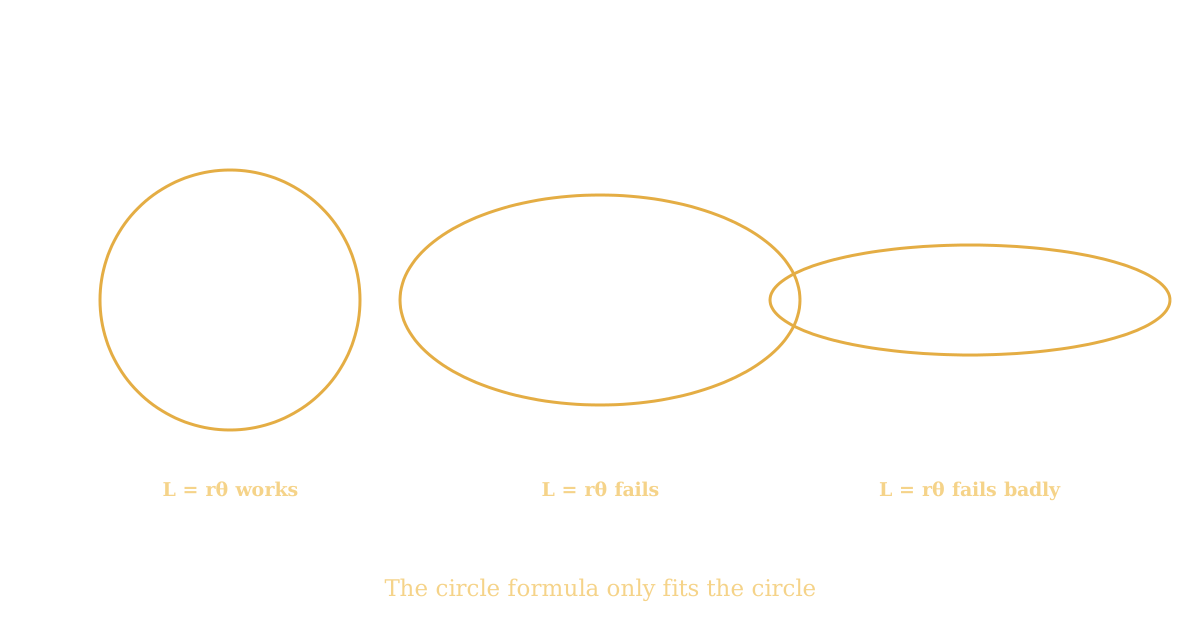
Compare a 90° arc on three shapes with the same nominal size:
| Shape | Axes | Quarter arc | Circle formula would give |
|---|---|---|---|
| Circle | r = 5 | 7.853981634 | 7.853981634 (correct) |
| Ellipse | a = 5, b = 3 | 6.3817497158 | 7.853981634 (too large) |
| Ellipse | a = 5, b = 4 | 7.0904169722 | 7.853981634 (too large) |
Using r = 5 in the circle formula overestimates the ellipse quarter arc by about 23% when b = 3, and by about 11% when b = 4. The error shrinks as the ellipse approaches a circle and grows as it flattens, which is exactly what you would expect: the circle formula is the limit of the ellipse formula as b approaches a, not a general substitute for it.
The calculator never uses the circle formula for an ellipse. It integrates the exact ellipse integrand, and only when a = b does that integration reduce to L = rθ, which the calculator also verifies internally as a consistency check.
Shortest vs Longest Arc Between Two Points
Two points on an ellipse divide the curve into two arcs: one going counterclockwise and one going clockwise. They are not mirror images, because the ellipse is not a circle, so the two arcs have different lengths. The shorter one is the shortest path along the curve between the points; the longer one is the rest of the ellipse.
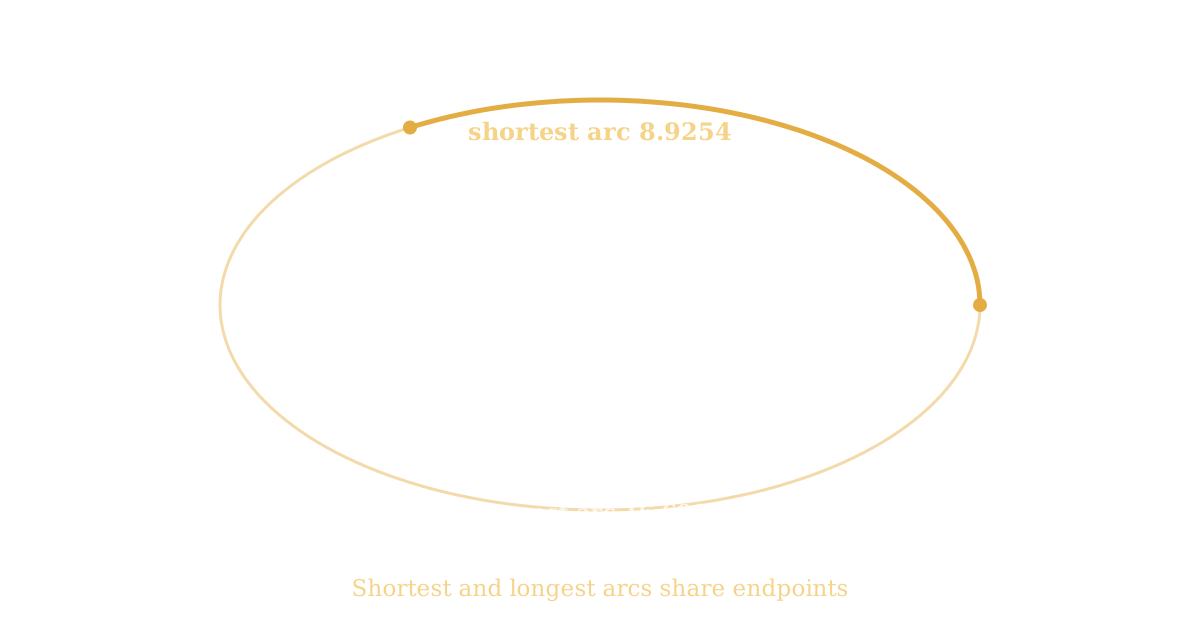
Take a = 5, b = 3, with endpoints at 0° and 120°:
| Path | Angles travelled | Length | Share of perimeter |
|---|---|---|---|
| Counterclockwise | 0° to 120° | 8.9253958986 | 34.9645% |
| Clockwise | 120° to 360° | 16.6016029648 | 65.0355% |
The two lengths add up to the full perimeter, 25.5269988634, as they must, since together they cover the whole ellipse. The shortest arc is 8.9253958986 and the longest is 16.6016029648. Notice that the angular split is 120° versus 240°, a one-to-two ratio, while the length split is roughly 35% versus 65%: the lengths do not follow the angles, because the curve moves faster near the minor axis than near the major axis.
That is why the calculator measures both paths by actual integration instead of comparing angles. Comparing angular differences would give the wrong winner whenever the ellipse is far from circular. Choose Shortest physical arc when you need the shorter route, for example the shortest cable run between two points on an elliptical frame, and Longest physical arc when you need the rest of the curve.
Angles, Direction, and the 0°/360° Wrap
Parametric angles on an ellipse wrap around: 360° is the same point as 0°, and 370° is the same point as 10°. The calculator handles that wrap for you, but it helps to know the rules it follows.
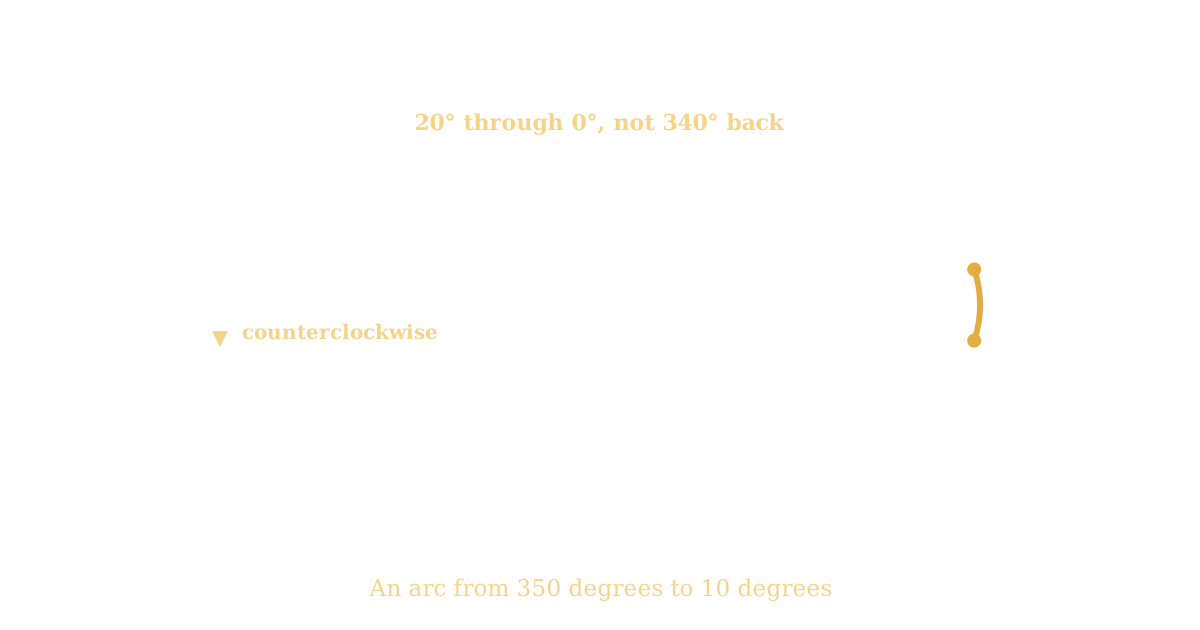
Counterclockwise means the angle increases from θ1 to θ2, wrapping past 360° when needed. An arc from 350° to 10° counterclockwise travels 20° through 0°, not 340° backward. For a = 5 and b = 3 that arc measures 1.0565175692 units, the same as the arc from −10° to 10°.
Clockwise means the angle decreases from θ1 to θ2. An arc from 10° to 350° clockwise is the same 20° arc through 0°, while the same pair counterclockwise would travel 340° the long way around.
Equal angles give a zero-length arc. If θ1 and θ2 are the same, the start and end points coincide and there is no arc between them. For a complete ellipse, enter 0° to 360° instead: that is one full revolution, and the calculator returns the whole perimeter.
Negative angles are allowed and mean the same points as their positive equivalents: −30° is the same point as 330°. The calculator normalizes every angle into the 0° to 360° range before integrating, so −30° to 30° and 330° to 30° give the same answer.
Radians follow the same rules with 2π in place of 360°. Switch the DEG and RAD toggle before typing radian values, since 1.57 radians and 1.57 degrees describe very different arcs.
Special Cases: Circle, Quarter, Half, and Full Ellipse
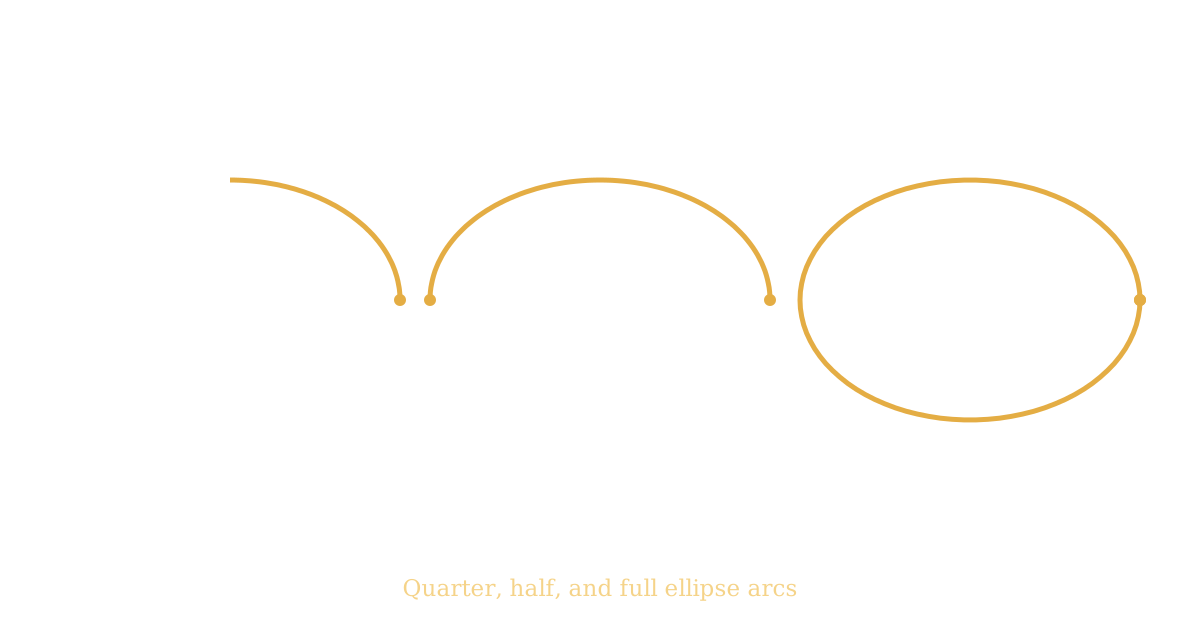
A few angle intervals come up so often that they deserve their own names. The table below lists them for the ellipse a = 5, b = 3 and for a circle of radius 5, all verified by the calculator.
| Case | Angles | Ellipse a = 5, b = 3 | Circle r = 5 |
|---|---|---|---|
| Zero-length arc | 45° to 45° | 0 | 0 |
| Quarter ellipse | 0° to 90° | 6.3817497158 | 7.853981634 |
| Half ellipse | 0° to 180° | 12.7634994317 | 15.7079632679 |
| Three-quarter ellipse | 0° to 270° | 19.1452491475 | 23.5619449019 |
| Complete ellipse | 0° to 360° | 25.5269988634 | 31.4159265359 |
Circle (a = b). The ellipse becomes a circle, the integrand becomes the constant radius, and L = rθ with θ in radians. A quarter circle of radius 5 is 5 × π/2 = 7.853981634, and the full circumference is 2πr = 31.4159265359.
Very elongated ellipses. When b is much smaller than a, the ellipse is almost a flat line segment traced out and back. The perimeter approaches 4a, and the quarter arc approaches a. For a = 10 and b = 1, the quarter arc is 10.1599354503, only slightly more than a itself.
Very flat ellipses. The same idea applies in the other direction: the arc concentrates near the ends of the major axis, where the curve turns sharply, and the numerical integration must refine its intervals there. Adaptive Simpson's rule handles that automatically.
Worked Example: Arc from 30° to 120°
Work through a complete example with a = 10, b = 6, from θ1 = 30° to θ2 = 120°. This is a 90° sweep that does not start on an axis, so it tests every part of the method.
- Convert the angles. 30° = π/6 ≈ 0.5235987756 radians. 120° = 2π/3 ≈ 2.0943951024 radians.
- Write the integral. L = ∫0.52359877562.0943951024 √(100 sin2θ + 36 cos2θ) dθ.
- Sample the integrand. At 30° it is √(100 × 0.25 + 36 × 0.75) = √52 ≈ 7.2111025509. At the midpoint 75° it is ≈ 9.7832925399. At 120° it is √(100 × 0.75 + 36 × 0.25) = √84 ≈ 9.1651513899.
- Estimate roughly. The midpoint value times the interval width, 9.7832925399 × 1.5707963268 ≈ 15.3675599856, is a rough estimate. It overshoots because the integrand is not constant.
- Integrate accurately. Adaptive Simpson's rule refines the interval until the answer is stable, giving L ≈ 14.4818404027 units.
- Check the endpoints. The start point is (10 cos 30°, 6 sin 30°) = (8.660254, 3). The end point is (10 cos 120°, 6 sin 120°) = (−5, 5.196152). The calculator shows both points with every result.
- Compare with the perimeter. The full perimeter is P ≈ 51.0539977268, so this arc is 28.3657% of the ellipse, even though it sweeps 90°. Ramanujan's approximation gives 51.0539977256, agreeing to nine decimal places.
The key lesson is in step 7: a 90° sweep is not one quarter of the perimeter unless it runs from one axis to the next. Here the same 90° of angle covers only 28.3657% of the curve, because the sweep crosses the minor axis, where the curve moves fastest, and misses the slow stretch near the major axis.
Practical Applications of Ellipse Arc Length
Ellipse arc length is not only a classroom exercise. It appears wherever an elliptical shape has to be measured, cut, or built.
Mechanical engineering. Elliptical gears, cams, and linkages all move along elliptical paths. Knowing the arc length between two cam angles tells an engineer how far a follower travels, which sets the timing of the mechanism.
Architecture. Elliptical arches, domes, and courtyards need exact perimeter and partial-arc measurements before stone or steel is ordered. An arch that spans only part of an ellipse needs the arc length of that part, not the whole perimeter.
Manufacturing and CNC machining. A CNC mill cutting an elliptical pocket or an elliptical flange follows the curve in small steps. The total tool path length comes from the arc integral, and it determines machining time and tool wear.
Elliptical tracks and structures. Running tracks, velodromes, and elliptical pipes are measured in arc lengths. A pipe elbow that bends through part of an ellipse needs the arc length of the bend to cut the material to size.
CAD and technical drawing. Ellipses are basic entities in CAD software, and their arc lengths feed into dimensioning, area calculations, and bill-of-materials lengths for trim and edging.
Physics and geometry education. Planetary orbits are ellipses, and the distance a planet travels along its orbit between two angles is an ellipse arc length. The same integral appears in optics, where elliptical mirrors focus light, and in the study of elliptic integrals themselves.
Common Mistakes When Calculating Ellipse Arc Length
Most errors in ellipse arc length come from treating the ellipse like a circle or from mixing up the inputs. Watch for these seven.
- Using the circle formula for an ellipse. L = rθ only works when a = b. For a = 5 and b = 3 it overestimates a quarter arc by about 23%.
- Confusing full axes with semi-axes. If the full width is 10, then a = 5. Entering 10 as a doubles every length the calculator returns. Use full-axis mode if you measured the full lengths.
- Forgetting to convert degrees into radians. The formulas use radians. An angle of 90 entered as radians is more than fourteen full revolutions, not a quarter turn. Check the DEG and RAD toggle before typing.
- Using the wrong angle convention. The angles here are parametric angles measured from the centre, x = a cos θ, y = b sin θ. They are not the polar angle of the point, which differs except on the axes.
- Ignoring clockwise versus counterclockwise paths. Two points define two arcs, and they are not equal on an ellipse. Pick the direction you actually mean, or use the shortest and longest options to see both.
- Assuming a quarter ellipse is always one-quarter of the perimeter. That holds only for arcs that run from one axis to the next. A 90° sweep from 30° to 120° is 28.3657% of its perimeter, not 25%.
- Treating Ramanujan's approximation as an exact partial-arc formula. Ramanujan's formula approximates the whole perimeter. It says nothing about a partial arc, and it must never be scaled down by an angle fraction to estimate one.
Quick Reference: Common Ellipse Configurations
Use this table as a quick check for your own calculations. All values were produced by the calculator on this page.
| Configuration | Arc | Length | Perimeter |
|---|---|---|---|
| a = 4, b = 2 | Quarter (0° to 90°) | 4.8442241103 | 19.3768964411 |
| a = 5, b = 3 | Quarter (0° to 90°) | 6.3817497158 | 25.5269988634 |
| a = 5, b = 3 | Half (0° to 180°) | 12.7634994317 | 25.5269988634 |
| a = 5, b = 3 | Full (0° to 360°) | 25.5269988634 | 25.5269988634 |
| a = 5, b = 5 (circle) | Quarter (0° to 90°) | 7.853981634 | 31.4159265359 |
| a = 10, b = 6 | 30° to 120° | 14.4818404027 | 51.0539977268 |
| a = 10, b = 1 | Quarter (0° to 90°) | 10.1599354503 | 40.6397418010 |
The last row shows how a very flat ellipse behaves: with a = 10 and b = 1, the quarter arc is only slightly longer than a itself, and the perimeter is only slightly more than 4a = 40. When b shrinks toward zero, the ellipse collapses toward a line segment traced out and back, and its perimeter approaches 4a.
Ellipse Arc Length Formula Reference
Keep these formulas together for quick reference. They cover every calculation on this page.
Angles in these formulas are in radians. To convert, multiply degrees by π/180. The Ramanujan line is an approximation for the whole perimeter only, while the integral lines are exact and are evaluated numerically by the calculator.
Ellipse Arc Length FAQs
How do you calculate the arc length of an ellipse? +
Enter the semi-major axis a, the semi-minor axis b, and the start and end angles, then evaluate L = ∫ √(a<sup>2</sup> sin<sup>2</sup>θ + b<sup>2</sup> cos<sup>2</sup>θ) dθ between the two angles. The integral has no elementary closed form, so the calculator evaluates it numerically with adaptive Simpson's rule. For example, a = 5, b = 3, from 0° to 90° gives 6.3817497158 units.
What is the formula for ellipse arc length? +
The formula is L = ∫<sub>θ<sub>1</sub></sub><sup>θ<sub>2</sub></sup> √(a<sup>2</sup> sin<sup>2</sup>θ + b<sup>2</sup> cos<sup>2</sup>θ) dθ, where a is the semi-major axis, b is the semi-minor axis, and θ<sub>1</sub> and θ<sub>2</sub> are the parametric start and end angles. The integrand is the speed of the point (a cos θ, b sin θ) as θ increases. The complete perimeter is four times the same integral from 0 to π/2.
Does an ellipse have an exact arc length formula? +
Yes, but it is an elliptic integral, not an elementary formula. The arc length equals a × (E(θ<sub>2</sub>, k) − E(θ<sub>1</sub>, k)), where E is the incomplete elliptic integral of the second kind and k = √(1 − (b/a)<sup>2</sup>) is the eccentricity. Elliptic integrals cannot be evaluated with ordinary functions alone, so in practice the integral is computed numerically, which is what this calculator does.
Why is ellipse arc length difficult to calculate? +
Because the integrand √(a<sup>2</sup> sin<sup>2</sup>θ + b<sup>2</sup> cos<sup>2</sup>θ) has no elementary antiderivative. On a circle the integrand is the constant radius, so the integral is a single multiplication, L = rθ. On an ellipse the integrand changes with θ, so the length must be accumulated piece by piece, either with an elliptic integral function or with numerical integration.
What is the difference between an ellipse's arc length and perimeter? +
The perimeter is the length of the whole closed ellipse, while an arc length is the length of one piece of it. The perimeter is the arc from 0° to 360°. For a = 5 and b = 3 the perimeter is 25.5269988634 units, a quarter arc is 6.3817497158, and a half arc is 12.7634994317. The calculator reports the arc, the perimeter, the complementary arc, and the percentage of the perimeter in every result.
How do you calculate a quarter ellipse arc? +
Set the start angle to 0° and the end angle to 90°, then integrate. A quarter ellipse that starts and ends on the axes is exactly one quarter of the perimeter by symmetry. For a = 5 and b = 3 the quarter arc is 6.3817497158 units, which is exactly 25% of the perimeter 25.5269988634. The Quarter Ellipse preset button loads these values for you.
Can I calculate an ellipse arc in degrees? +
Yes. Use the DEG and RAD toggle at the top of the calculator and enter your angles in degrees. The calculator converts them to radians before integrating, since the formulas use radians. Entering 90 in degrees means a quarter turn; entering 90 in radians would mean more than fourteen full revolutions, so always check the toggle first.
What are the semi-major and semi-minor axes? +
The semi-major axis a is the distance from the centre of the ellipse to the farthest point on its boundary, half the longest diameter. The semi-minor axis b is the distance from the centre to the nearest point on the boundary, half the shortest diameter. For an ellipse with full width 10 and full height 6, a = 5 and b = 3. When a = b, the ellipse is a circle.
Is an ellipse arc length always longer than a circle arc? +
No. For the same angle and the same a, an ellipse arc is shorter than the corresponding circle arc of radius a, because the ellipse sits inside that circle. A quarter arc with a = 5 and b = 3 is 6.3817497158, while a quarter circle of radius 5 is 7.853981634. The ellipse arc is longer than a circle arc of radius b, so it always lies between the two circle values.
Can I calculate the shortest arc between two points on an ellipse? +
Yes. Choose Shortest physical arc as the direction. The calculator integrates both paths between the points, the counterclockwise arc and the clockwise arc, and reports the shorter one. For a = 5, b = 3, between 0° and 120°, the counterclockwise arc is 8.9253958986 and the clockwise arc is 16.6016029648, so the shortest arc is 8.9253958986. The Longest physical arc option reports the other one.
How accurate is Ramanujan's perimeter approximation? +
Very accurate for ordinary ellipses. For a = 5 and b = 3 it gives 25.5269988628 against the exact numerical perimeter 25.5269988634, agreeing to nine decimal places. The error grows for extremely flat ellipses, but it stays small for the shapes used in practice. Remember that it approximates the whole perimeter only and cannot be used for a partial arc.
What happens if the start and end angles are the same? +
The arc length is zero, because the start and end points coincide and there is no arc between them. If you want the complete ellipse, enter 0° to 360° instead: that is one full revolution, and the calculator returns the whole perimeter, 25.5269988634 units for a = 5 and b = 3.