Semicircle Arc Length Calculator
Find the curved length of any semicircle from its radius or diameter, instantly.
Original Curve & Selected Arc
Gold dots mark the midpoint of each subinterval.
Integrand g(x) & Midpoint Rectangles
Hover a rectangle for its subinterval, midpoint, integrand value and contribution.
Detailed Midpoint Calculation Table
Convergence Comparison
Differences between successive refinements are a practical error indicator, not a guaranteed error bound.
Calculation Error
Section Navigation
How to Use the Semicircle Arc Length Calculator
The Semicircle Arc Length Calculator measures the curved length of a semicircle from any one measurement you already have: radius, diameter, full circle circumference, or semicircle area. The page opens with the Semicircle panel active, showing the formula L = πr. Follow these steps to get a correct answer in under a minute.
- Choose the input method. Pick Radius, Diameter, Full Circle Circumference, or Semicircle Area. The input field, its label, and its unit list change to match the method you pick.
- Enter your measurement. Type the value in the input box. For area input, use the squared unit list (mm², cm², m², km², in², ft², yd²).
- Choose input and output units. The calculator converts your input into a consistent internal unit, calculates, then converts the answer into your output unit. The number changes with the unit; the length does not.
- Pick an orientation. Upper, Lower, Left, or Right changes only the live diagram. The arc length stays exactly the same for the same radius.
- Choose a precision. Pick 2, 4, 6, or 8 decimal places. The default is 4. The calculator always uses full-precision π internally and rounds only the displayed result.
- Click Calculate Now. The calculator shows the curved arc length as the main result, plus the radius, diameter, total perimeter, semicircle area, full circle circumference, full circle area, central angle, chord length, and arc-to-diameter ratio.
- Explore the diagram. The live diagram draws the semicircle with its centre O, radius r, diameter d, endpoints, and 180° central angle. Use the toggles to show or hide the radius, diameter, centre point, and angle information.
- Copy, print, or reset. Use Copy Result to place the answer on your clipboard, Print Summary for a simple report, or Reset to clear the panel. The Swap Orientation button cycles through the four orientations in one click.
Try an example. The preset buttons load verified values instantly: radius 5 gives 15.7079632679 units, diameter 12 gives 18.8495559215 units, radius 10 gives 31.4159265359 units, radius 7.5 gives 23.5619449019 units, area 50 gives radius 5.6418958355 and arc length 17.7245385091 units, and circumference 62.8318530718 gives radius 10 and arc length 31.4159265359 units.
Important tips. Keep all values in the same unit before comparing them. Arc length is the curved boundary only; the diameter is not part of it. If you enter a diameter, the calculator halves it to find the radius first. A zero or negative measurement is not a valid semicircle, so the calculator rejects it instead of showing a misleading answer.
What Is the Arc Length of a Semicircle?
A semicircle is exactly half of a circle, cut along a diameter. It has a curved boundary, called the arc, and a straight boundary, the diameter. The arc length of a semicircle is the distance along the curved boundary only, from one endpoint of the diameter to the other, following the curve.
Picture a semicircular arched window. The arc length is the length of the curved frame around the top. The straight sill across the bottom is the diameter, and it is not part of the arc length. If you bent a straight measuring tape around the curve, the reading on the tape would be the arc length.
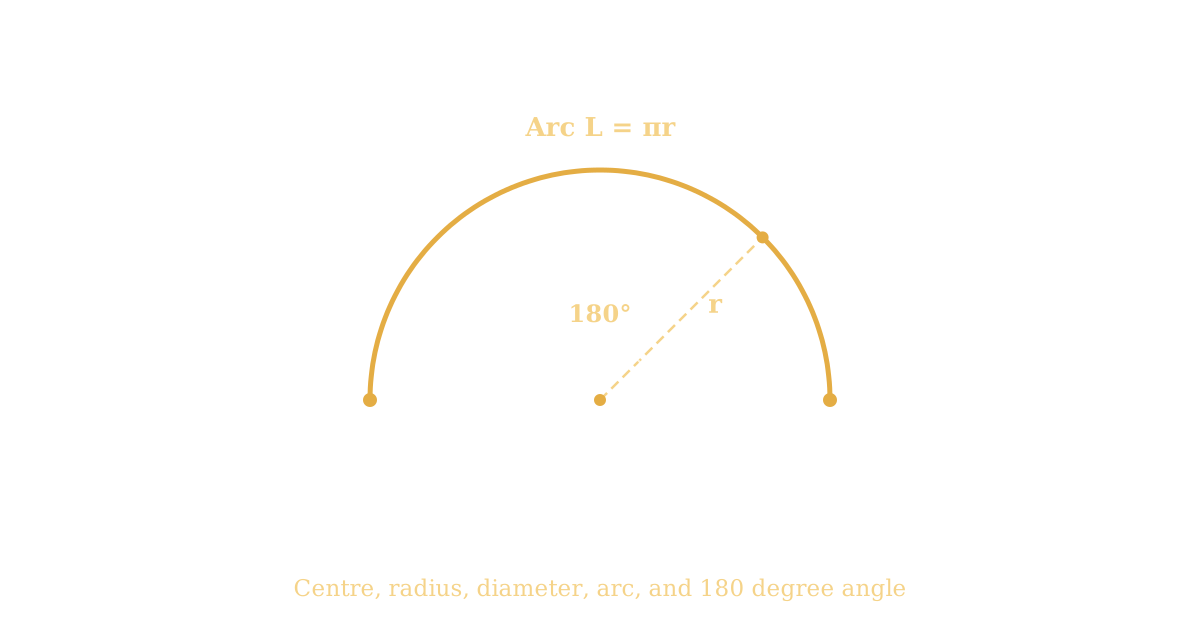
Every semicircle has the same shape, scaled by its radius. The centre O sits at the midpoint of the diameter. The radius r runs from O to any point on the arc. The diameter d runs from one endpoint to the other through O, and it is always twice the radius. The central angle, the angle at O between the two radii to the endpoints, is always 180°, which is π radians.
Arc length differs from the diameter in a way that surprises many people: the curve is longer than the straight line across it. For a radius of 5 units, the diameter is 10 units, but the arc is 15.7079632679 units, about 57.08% longer than the diameter. That extra length is the whole reason arc length needs its own calculation.
A semicircle is not the same as a half circle drawn any old way. The cut must pass through the centre, so the two halves are equal and each central angle is exactly 180°. A shape cut off-centre is a circular segment, not a semicircle, and its arc length follows a different formula.
Semicircle Arc Length Formula
The arc length of a semicircle comes straight from the circumference of a full circle. The circumference of a complete circle is:
A semicircle is half of that circle, so its curved boundary is half of the full circumference:
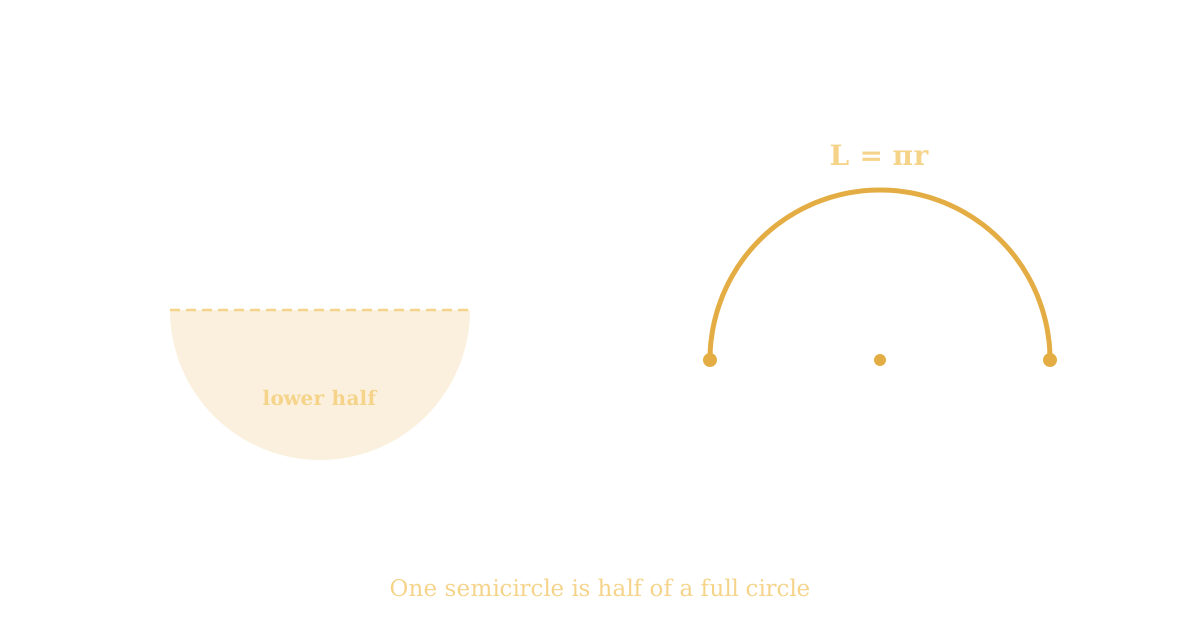
Each symbol in the formula has a precise meaning:
| Symbol | Meaning | Notes |
|---|---|---|
| L | Arc length | The curved distance along the semicircle |
| r | Radius | Distance from the centre to the arc |
| d | Diameter | d = 2r, the straight edge of the semicircle |
| π | Pi | 3.141592653589793, the circle constant |
| θ | Central angle | Always 180°, or π radians, for a semicircle |
Using the diameter instead of the radius gives a second form of the same formula. Since d = 2r, then r = d / 2, and substituting gives:
Both forms give the same answer. Use L = πr when you know the radius, and L = πd / 2 when you know the diameter. The general arc-length formula L = rθ also agrees: with θ = π radians, L = r × π = πr.
How to Calculate Semicircle Arc Length
Calculating a semicircle arc length by hand follows six steps. The worked example below uses a radius of 5 cm.
- Identify the radius. r = 5 cm.
- Write the semicircle arc-length formula. L = πr.
- Substitute the radius. L = π × 5.
- Multiply by π. π × 5 = 15.7079632679, using full-precision π = 3.141592653589793.
- Attach the unit. The answer is a length, so it takes the same unit as the radius: centimetres.
- Round to the required precision. To two decimal places, L = 15.71 cm. To four decimal places, L = 15.7080 cm.
The same six steps work for any radius. A radius of 3 units gives L = π × 3 = 9.4247779608 units. A radius of 8 units gives L = π × 8 = 25.1327412287 units. A radius of 1 unit gives L = π = 3.1415926536 units, which is the shortest semicircle arc you can get with a whole-number radius and also a useful check: if your calculator gives anything else for r = 1, something is wrong.
Rounding rule. Round only at the end. If you replace π with 3.14 before multiplying, a radius of 5 gives 15.70 instead of 15.7079632679, an error of 0.0079632679. That error grows with the radius, so keep full precision through the calculation and round only the final displayed result.
How to Calculate Semicircle Arc Length Using Diameter
When you know the diameter instead of the radius, divide by two first, then apply the same formula. The worked example below uses a diameter of 12 units.
- Identify the diameter. d = 12 units.
- Find the radius. r = d / 2 = 12 / 2 = 6 units.
- Write the formula. L = πr, or directly L = πd / 2.
- Substitute. L = π × 6, or L = π × 12 / 2.
- Calculate. L = 18.8495559215 units.
- Round as needed. To two decimal places, L = 18.85 units.
Both routes agree exactly, which is a good self-check. The radius route gives π × 6 = 18.8495559215. The diameter route gives π × 12 / 2 = 18.8495559215. If the two disagree, the radius was not halved correctly.
Another example: a diameter of 20 units gives r = 10 units, so L = π × 10 = 31.4159265359 units. A diameter of 15 units gives r = 7.5 units, so L = π × 7.5 = 23.5619449019 units. The most common error in this calculation is forgetting the division by two and using the diameter as if it were the radius, which doubles the answer. For d = 12, that mistake gives 37.6991118431 instead of 18.8495559215.
Measuring tip. Diameters are often easier to measure in real life than radii, because you can measure straight across the flat edge. That is why the calculator accepts diameter input directly: measure the flat edge, enter it, and the calculator halves it for you.
Calculating from Circumference or Area
Sometimes neither the radius nor the diameter is given. The calculator also works backwards from the full circle circumference or from the semicircle area, by deriving the radius first.
From full circle circumference. The full circumference is C = 2πr, so r = C / (2π). For C = 62.8318530718 units, r = 62.8318530718 / (2π) = 62.8318530718 / 6.2831853072 = 10 units. Then L = πr = π × 10 = 31.4159265359 units. Notice the semicircle arc is exactly half the full circumference, which is a quick check: 62.8318530718 / 2 = 31.4159265359.
From semicircle area. The area of a semicircle is A = πr² / 2, so rearranging gives r = √(2A / π). For A = 50 square units, r = √(100 / π) = √(31.8309886184) = 5.6418958355 units. Then L = πr = π × 5.6418958355 = 17.7245385091 units. You can verify the radius by putting it back into the area formula: π × 5.6418958355² / 2 = 50.0000000000 square units.
A second area example. For A = 100 square units, r = √(200 / π) = 7.9788456080 units, and L = π × 7.9788456080 = 25.0662827463 units. Area grows with the square of the radius, so doubling the area does not double the radius: it multiplies the radius by √2, about 1.4142.
Which input to use. Use whichever measurement you actually have. All four methods derive the same radius and give the same arc length. If two different measurements give different radii, one of the measurements is wrong, and that disagreement is worth investigating before trusting either answer.
Difference Between Semicircle Arc Length and Perimeter
This is the distinction that causes the most confusion, so it deserves a careful look. Arc length and perimeter are two different measurements of the same shape.
Arc length is the curved boundary only: L = πr. Total perimeter is the complete boundary: the curved arc plus the straight diameter, P = πr + 2r, which factors to P = r(π + 2).
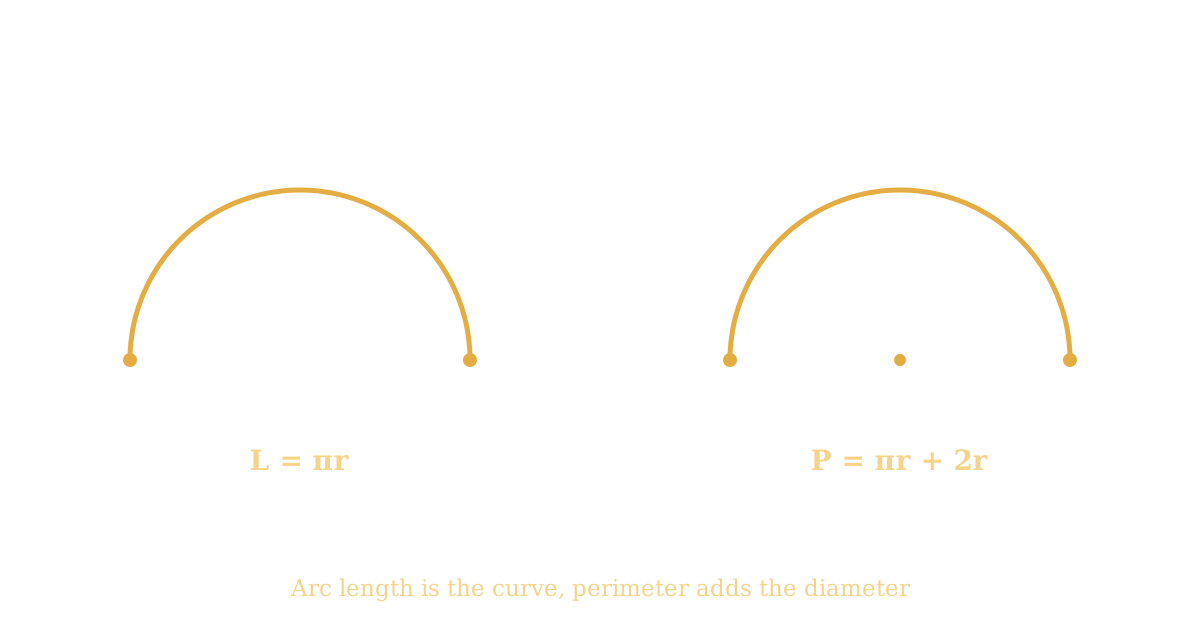
For a radius of 5 units, the arc length is 15.7079632679 units and the total perimeter is 25.7079632679 units. The difference is exactly the diameter, 10 units. The arc is only about 61.10% of the total perimeter; the straight edge makes up the rest.
| Radius | Arc length L = πr | Diameter 2r | Perimeter P = πr + 2r |
|---|---|---|---|
| 3 | 9.4247779608 | 6 | 15.4247779608 |
| 5 | 15.7079632679 | 10 | 25.7079632679 |
| 10 | 31.4159265359 | 20 | 51.4159265359 |
Why it matters. If you are buying edging for a semicircular garden bed, the curved edging needs the arc length, but the straight edge along the path needs the diameter too, so you need the perimeter. If you are buying trim for an arched window, only the curve needs trim, so you need the arc length. Using the wrong one either wastes material or leaves you short. The calculator shows both results separately, clearly labelled, so you can pick the one your job needs.
A note on wording. Many people search for "semicircle perimeter" when they mean the curved arc. Textbooks also vary: some call the total boundary the perimeter and the curve the arc length, while others loosely call the curve the perimeter. On this page, arc length always means the curve only, and perimeter always means the complete boundary including the diameter.
Semicircle Area vs Arc Length
Area and arc length measure different things, and confusing them is one of the most common errors in semicircle problems. Area is the two-dimensional space inside the semicircle. Arc length is the one-dimensional distance along its curved boundary. Perimeter is the complete boundary length.
| Quantity | Formula | Measures | Units |
|---|---|---|---|
| Arc length | L = πr | Curved boundary | Linear (cm, m, ft) |
| Perimeter | P = πr + 2r | Complete boundary | Linear (cm, m, ft) |
| Area | A = πr² / 2 | Surface inside | Square (cm², m², ft²) |
For a radius of 5 units, the arc length is 15.7079632679 units and the area is 39.2699081699 square units. The numbers differ, and the units differ too: lengths use plain units, areas use square units. If your answer comes out in square units, you calculated an area, not a length.
Area grows faster than arc length. Double the radius, and the arc length doubles, but the area quadruples, because area depends on r². Compare r = 4 and r = 8: the arc lengths are 12.5663706144 and 25.1327412287, a factor of 2, while the areas are 25.1327412287 and 100.5309649149, a factor of 4. That is why a small change in radius changes the area far more than it changes the arc length.
Unit check. The units are your best defence. If a problem asks for a length and your answer is in square centimetres, stop and recheck. If it asks for an area and your answer is in plain centimetres, the same applies. The calculator keeps the two apart: area input uses squared units, and the area result is labelled in squared units.
Relationship Between Radius and Diameter
The radius and diameter of a semicircle are locked together by a single rule: the diameter is twice the radius.
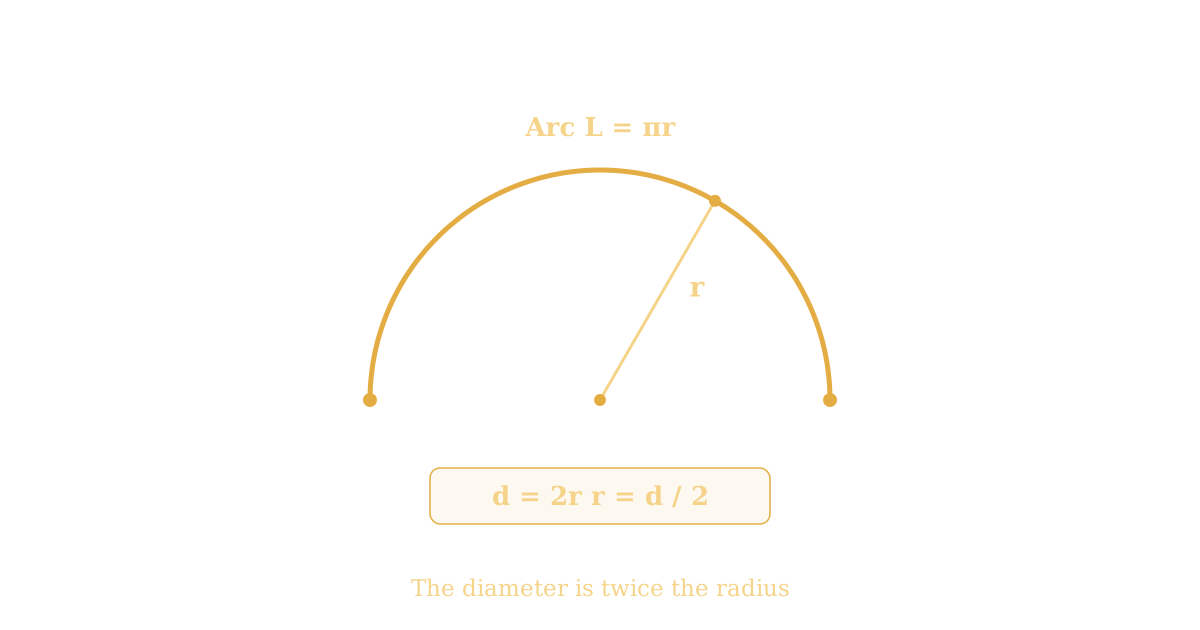
The radius runs from the centre O to the arc. The diameter runs from one endpoint to the other, passing through O. Because the diameter is two radii laid end to end, d = 2r always, for every circle and every semicircle. The radius is the more fundamental measurement: every circle formula is written in terms of r, and the diameter is just a convenience for measuring.
| Given | Radius | Diameter | Arc length |
|---|---|---|---|
| r = 2.5 | 2.5 | 5 | 7.8539816340 |
| r = 5 | 5 | 10 | 15.7079632679 |
| d = 12 | 6 | 12 | 18.8495559215 |
| d = 20 | 10 | 20 | 31.4159265359 |
Chord connection. The diameter is also the longest chord of the semicircle: the straight line joining the two endpoints of the arc. Every semicircle has a central angle of 180°, so its chord is always the diameter, 2r. That is why the calculator reports the chord length as equal to the diameter.
Practical note. When you measure a real semicircle, measure the diameter if you can, because the flat edge is easy to reach with a tape. Then halve it. Measuring the radius directly means finding the centre first, which is harder on a physical object. Either way, the calculator accepts both.
Why Is Pi Used in Semicircle Arc Length?
Pi (π) is the ratio of a circle's circumference to its diameter, and it is the same for every circle, large or small. That universality is why π appears in every circle formula, including the semicircle arc length.
For any circle, C / d = π, always. Since a semicircle is half a circle, its arc is half the circumference, and half of C = 2πr is πr. The π in the formula is not a fudge factor: it is the exact constant that converts a radius into a curved length, because a curve is longer than the straight radius by exactly that factor.
Pi is irrational. Its decimal expansion never ends and never repeats: 3.141592653589793 and on forever. That means no finite decimal equals π exactly. Textbooks often round it to 3.14 for hand calculations, and that is fine for rough work, but it introduces an error. For a radius of 5, π = 3.14 gives 15.70, while full-precision π gives 15.7079632679, an error of 0.0079632679. For a radius of 100, the same shortcut gives 314 instead of 314.1592653590, an error of 0.1592653590. The error scales with the radius, so on large jobs it stops being negligible.
What the calculator does. It uses the full-precision value of π built into the browser (3.141592653589793) for every calculation, and rounds only the displayed result to your chosen precision. The optional π = 3.14 comparison shows both answers side by side, so you can see exactly how much the shortcut costs on your numbers.
A note on angle units. The formula L = rθ needs θ in radians. A semicircle spans π radians, which is 180°. If you put 180 into L = rθ without converting, you get 180r, which is wrong by a factor of about 57.3. The calculator handles the conversion, but when working by hand, always convert degrees to radians first: θ in radians = degrees × π / 180.
Upper, Lower, Left and Right Semicircles
A semicircle can face four ways: the flat diameter can sit at the bottom (upper semicircle), at the top (lower semicircle), on the right (left semicircle), or on the left (right semicircle). The orientation changes the picture, not the mathematics.
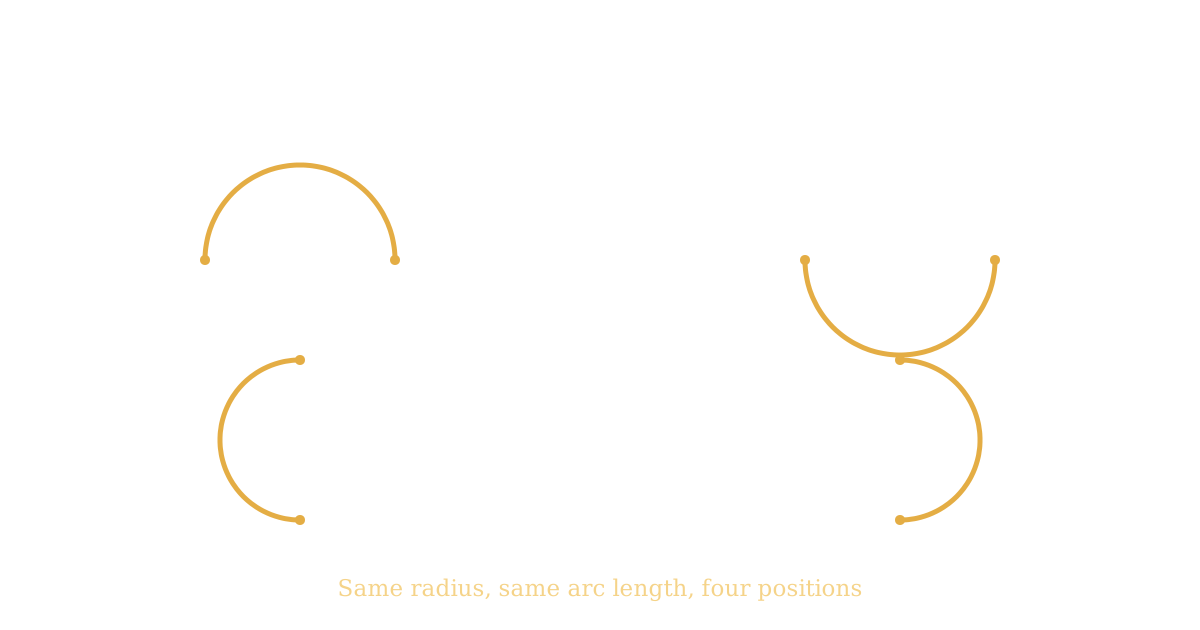
For a radius of 5 units, all four orientations have the same arc length, 15.7079632679 units, the same diameter, 10 units, the same perimeter, 25.7079632679 units, and the same area, 39.2699081699 square units. Only the direction the curve bulges changes. That is because the formulas depend only on r, and r does not depend on which way the shape points.
Where each orientation appears. Upper semicircles are the classic arch: windows, doorways, and bridges curve upward. Lower semicircles appear as bowls, basins, and the bottoms of tanks. Left and right semicircles appear in sideways arches, decorative panels, and diagrams where the flat edge is vertical. In coordinate geometry, an upper semicircle is the graph of y = √(r² − x²), and a lower one is y = −√(r² − x²), for x between −r and r.
Try it in the calculator. Enter a radius, calculate, then use the Swap Orientation button to cycle through the four positions. Watch the diagram rotate while every number in the results stays exactly the same. That is the point: orientation is a drawing choice, and the arc length is a property of the size.
Arc-to-Diameter Ratio
There is a fixed relationship between a semicircle's arc length and its diameter, and it is the same for every semicircle, whatever its size.
Because L = πr and d = 2r, dividing gives L / d = πr / 2r = π / 2. The radius cancels out, so the ratio never changes. The curved arc is always about 1.5708 times as long as the diameter, or about 57.08% longer.
| Radius | Diameter | Arc length | L / d |
|---|---|---|---|
| 1 | 2 | 3.1415926536 | 1.5707963268 |
| 2.5 | 5 | 7.8539816340 | 1.5707963268 |
| 5 | 10 | 15.7079632679 | 1.5707963268 |
| 10 | 20 | 31.4159265359 | 1.5707963268 |
Why this is useful. It gives you a one-line estimate and a sanity check. If you know a semicircular arch spans 4 metres across, its curved length is about 4 × 1.5708 = 6.2832 metres, before you even reach for a calculator. And if a calculation gives an arc shorter than its diameter, it is certainly wrong: the curve is always longer than the straight line across it.
A related check. The arc is also π times the radius, so L is always a little more than three times r. If your answer is less than 3r, or more than 3.2r, recheck your input. For r = 5, 3r = 15 and 3.2r = 16, and the true arc, 15.7079632679, sits between them, as it must.
Real-World Applications of Semicircle Arc Length
Semicircles appear wherever a curve needs to span a gap or soften a corner, and the arc length is the number that tells you how much material the curve needs.
Architecture and construction. Arched windows and doorways are the classic case: the curved trim, the glazing bead, or the stone arch follows the semicircle, so its length is πr. A window with a 1.2 metre radius needs about 3.7699 metres of curved trim, not 2.4 metres. The same applies to the curved edge of a semicircular balcony, a rounded countertop, or a half-round patio.
Bridges and structures. Semicircular arches carry loads in masonry bridges and aqueducts. Engineers need the arc length to calculate the length of the arch ring, the amount of voussoir stone, and the surface area of the curved soffit. A bridge arch with a 10 metre radius has an arc of 31.4159265359 metres.
Manufacturing and engineering. Curved pipes, half-round mouldings, gaskets, and seals are cut to the arc length. A semicircular duct bend with a 0.5 metre radius needs 1.5707963268 metres of sheet metal along the curve. Getting this wrong means a part that is too short to close or too long to fit.
Landscaping and interior design. A semicircular flower bed, lawn edge, or stage needs edging along the curve. A bed with a 3 metre radius needs 9.4247779608 metres of edging for the curve, plus 6 metres if the straight edge is edged too. The same logic applies to the curved border of a rug, a table, or a stage.
Geometry education. Semicircles are the first curved shape most students meet after the full circle, and they teach the difference between a curved length, a straight length, and an area in one small shape. The 180° central angle also makes them the simplest case of the general arc-length formula L = rθ.
A word of caution. Not every real-world arch is a perfect semicircle. Many arches are elliptical, pointed, or segmental, and their arc lengths follow different formulas. Before ordering material, check that the arch really is semicircular: measure the height of the arch and compare it with half the span. If the height equals half the span, it is a semicircle, and πr applies. If not, use the formula for the actual shape.
Common Mistakes When Calculating Semicircle Arc Length
Most semicircle errors come from a small list of mix-ups. Knowing them in advance is the cheapest way to avoid them.
- Using the diameter instead of the radius. The formula is L = πr, not L = πd. Using d = 12 directly gives 37.6991118431 instead of the correct 18.8495559215. Always halve the diameter first.
- Forgetting to divide the full circle circumference by two. The full circumference C = 2πr is twice the semicircle arc. For r = 10, C = 62.8318530718, but the semicircle arc is 31.4159265359. Halve it.
- Confusing arc length with total perimeter. The perimeter P = πr + 2r includes the diameter. The arc L = πr does not. For r = 5, the perimeter is 25.7079632679 and the arc is 15.7079632679. Pick the one your problem asks for.
- Including the diameter in the curved arc result. This is the same error from the other side: adding 2r to the arc when the question asks for the curve only. The diameter is straight, not curved.
- Confusing semicircle area with arc length. Area is A = πr² / 2 and is measured in square units. Arc length is L = πr and is measured in plain units. For r = 5, the area is 39.2699081699 square units and the arc is 15.7079632679 units. Different formulas, different units, different answers.
- Rounding π too early. Using 3.14 instead of full-precision π gives 15.70 instead of 15.7079632679 for r = 5, and the error grows with the radius. Keep full precision until the final step.
- Mixing different measurement units. A radius in centimetres and a diameter in metres cannot go into the same formula. Convert everything to one unit first. The calculator does this for you when you pick input and output units, but by hand you must convert before calculating.
- Using square units for a linear measurement. Arc length is a length. If your answer ends in cm² or m², you used an area formula by mistake. Check the units before trusting the number.
Quick self-check. After any semicircle calculation, test three things: is the arc longer than the diameter (it must be, by a factor of 1.5708), is it shorter than the full circumference (it must be, exactly half), and is it close to 3.14 times the radius? If all three hold, the answer is very likely right.
Semicircle Formula Reference
These are the five formulas the calculator uses, together in one place. Copy any of them with the button beside it in the calculator panel.
| Quantity | Formula | Example (r = 5) |
|---|---|---|
| Arc length (from radius) | L = πr | 15.7079632679 |
| Arc length (from diameter) | L = πd / 2 | 15.7079632679 |
| Total perimeter | P = πr + 2r | 25.7079632679 |
| Semicircle area | A = πr² / 2 | 39.2699081699 |
| Full circle circumference | C = 2πr | 31.4159265359 |
| Radius from area | r = √(2A / π) | 5 (from A = 39.2699081699) |
| Radius from circumference | r = C / (2π) | 5 (from C = 31.4159265359) |
| Arc-to-diameter ratio | L / d = π / 2 | 1.5707963268 |
Constants to remember. The central angle is always 180°, or π radians. The chord length is always the diameter, 2r. The arc is always π / 2 times the diameter. These three facts hold for every semicircle, whatever its size, and they make excellent checks on any calculation.
Worked Examples
These six examples cover every input method the calculator offers. Each one is calculated by the same engine that powers the tool, and each result has been verified independently.
Example 1: Semicircle with radius 5. Given r = 5 units. Arc length L = π × 5 = 15.7079632679 units. Diameter d = 10 units. Complete perimeter P = 15.7079632679 + 10 = 25.7079632679 units. Semicircle area A = π × 25 / 2 = 39.2699081699 square units.
Example 2: Semicircle with diameter 12. Given d = 12 units. Radius r = 12 / 2 = 6 units. Arc length L = π × 6 = 18.8495559215 units. Complete perimeter P = 18.8495559215 + 12 = 30.8495559215 units.
Example 3: Semicircle with radius 10. Given r = 10 units. Arc length L = π × 10 = 31.4159265359 units. Diameter d = 20 units. Complete perimeter P = 31.4159265359 + 20 = 51.4159265359 units.
Example 4: Semicircle with radius 7.5. Given r = 7.5 units. Arc length L = π × 7.5 = 23.5619449019 units. Diameter d = 15 units. Complete perimeter P = 23.5619449019 + 15 = 38.5619449019 units.
Example 5: Calculate from semicircle area. Given A = 50 square units. Radius r = √(2 × 50 / π) = √(100 / π) = 5.6418958355 units. Arc length L = π × 5.6418958355 = 17.7245385091 units. Check: π × 5.6418958355² / 2 = 50.0000000000 square units.
Example 6: Calculate from full circle circumference. Given C = 62.8318530718 units. Radius r = C / (2π) = 62.8318530718 / 6.2831853072 = 10 units. Expected semicircle arc length L = π × 10 = 31.4159265359 units, which is exactly half the given circumference.
Click any preset button in the calculator to load one of these examples and see the full step-by-step solution, the live diagram, and all the secondary results for that input.
Semicircle Arc Length FAQs
What is the formula for semicircle arc length? +
The formula is L = πr, where L is the curved arc length and r is the radius. If you know the diameter d instead, use L = πd / 2, which is the same formula with r replaced by d / 2. For a radius of 5 units, L = π × 5 = 15.7079632679 units.
How do you calculate the arc length of a semicircle? +
Identify the radius, then multiply it by π. If you only know the diameter, halve it first to get the radius. For example, a diameter of 12 units gives a radius of 6 units, and the arc length is π × 6 = 18.8495559215 units. The calculator on this page does the same steps and shows each one.
Is semicircle arc length half the circumference? +
Yes. A semicircle is half of a full circle, so its arc is half the full circumference. The full circumference is C = 2πr, and half of that is πr, which is the semicircle arc length. For a radius of 10 units, the full circumference is 62.8318530718 units and the semicircle arc is 31.4159265359 units.
How do you calculate semicircle arc length using diameter? +
Divide the diameter by two to get the radius, then use L = πr. Equivalently, use L = πd / 2 directly. For a diameter of 20 units, L = π × 20 / 2 = 31.4159265359 units. The most common error is forgetting the division by two, which doubles the answer.
What is the difference between arc length and semicircle perimeter? +
Arc length is the curved boundary only, L = πr. Total perimeter is the complete boundary, the curve plus the straight diameter: P = πr + 2r. For a radius of 5 units, the arc length is 15.7079632679 units and the perimeter is 25.7079632679 units. The difference is exactly the diameter, 10 units.
Is the diameter included in semicircle arc length? +
No. Arc length measures only the curved part of the boundary. The diameter is a straight line and is not part of the curve. If your problem asks for the total distance around the whole shape, that is the perimeter, P = πr + 2r, and the diameter is included there.
What is the central angle of a semicircle? +
The central angle of a semicircle is always 180°, which is π radians (about 3.1415926536 radians). It is the angle at the centre between the two radii that run to the endpoints of the diameter. This is true for every semicircle, whatever its size, because a semicircle is always exactly half a circle.
How do you calculate the area of a semicircle? +
Use A = πr² / 2, which is half the area of a full circle. For a radius of 5 units, A = π × 25 / 2 = 39.2699081699 square units. Note the units: area is measured in square units, while arc length is measured in plain units. The two are different quantities and must not be confused.
How many radians are in a semicircle? +
A semicircle spans π radians, about 3.1415926536 radians. A full circle spans 2π radians, so half a circle spans half of that. In degrees, the same angle is 180°. The general arc-length formula L = rθ needs the angle in radians, so for a semicircle it becomes L = r × π = πr.
Is semicircle arc length always greater than its diameter? +
Yes, always. The ratio is fixed: L / d = π / 2, about 1.5708, so the arc is always about 57.08% longer than the diameter. This is a useful check: if a calculation gives an arc shorter than the diameter, it is certainly wrong. A curve between two points is always longer than the straight line joining them.
Can I calculate semicircle arc length from its area? +
Yes. Rearrange the area formula A = πr² / 2 to get r = √(2A / π), then use L = πr. For an area of 50 square units, r = √(100 / π) = 5.6418958355 units, and L = π × 5.6418958355 = 17.7245385091 units. Choose the Semicircle Area input method in the calculator to do this in one step.
Why is pi used in the semicircle formula? +
Pi is the ratio of any circle's circumference to its diameter, the same for every circle. A semicircle arc is half a circumference, and half of 2πr is πr, so π appears because the length of any curve on a circle is tied to that ratio. Pi is irrational, so the calculator uses its full-precision value and rounds only the displayed result.
What is the difference between a semicircle and a half circle? +
There is no difference: the two terms mean the same shape, exactly half of a circle cut along a diameter. Semicircle is the formal mathematical term, and half circle is the everyday phrase. Both have a 180° central angle, a diameter of 2r, and an arc length of πr.
How do you convert semicircle arc length into inches, feet or meters? +
Calculate the arc length in one unit, then convert with the standard factors: 1 inch = 2.54 cm, 1 foot = 12 inches = 30.48 cm, 1 metre = 100 cm. For example, an arc of 15.7079632679 cm is 15.7079632679 / 2.54 = 6.1842375070 inches, or 0.1570796327 metres. The calculator does this automatically: pick your input unit and your output unit and it converts both the input and the result.