Parabola Arc Length Calculator
Measure any arc of a parabola from its equation and interval, step by step.
Original Curve & Selected Arc
Gold dots mark the midpoint of each subinterval.
Integrand g(x) & Midpoint Rectangles
Hover a rectangle for its subinterval, midpoint, integrand value and contribution.
Detailed Midpoint Calculation Table
Convergence Comparison
Differences between successive refinements are a practical error indicator, not a guaranteed error bound.
Calculation Error
Section Navigation
How to Use the Parabola Arc Length Calculator
The Parabola Arc Length Calculator measures the length of a curved segment of a parabola from its equation and two coordinates. The page opens with the Parabola Arc Length panel active, showing the formula L = ∫x1x2 √(1 + (dy/dx)2) dx. Follow these steps to get a correct answer in under a minute.
- Choose the equation form. Pick vertical vertex form, vertical general form, horizontal vertex form, horizontal general form, or standard focus form. The input fields change to match the form you pick.
- Enter the parabola parameters. For y = a(x − h)2 + k, enter a, h, and k. For y = ax2 + bx + c, enter a, b, and c. For focus form, enter p and the vertex (h, k).
- Enter the interval. Give the start and end coordinates: x values for a vertical parabola, y values for a horizontal one. The calculator finds both endpoints on the curve for you.
- Choose a unit and a precision. The unit labels the answer; the precision sets how many decimal places the result shows. Units run from millimetres to yards.
- Click Calculate Now. The calculator evaluates the exact arc-length formula and shows the arc length, the chord length, how much the arc exceeds the chord, the endpoints, the tangent slopes, and the vertex, focus, and directrix.
- Explore the graph. The interactive graph draws the parabola, highlights the selected arc in gold, and marks the vertex, focus, endpoints, and chord. Use the toggles to show or hide elements, and zoom or drag to inspect the curve.
- Copy or reset. Use Copy Result to place the answer on your clipboard, or Reset to clear the panel. The Swap Start and End button exchanges the two interval values in one click.
Try an example. The preset buttons load verified values instantly: y = 0.5x2 from x = −2 to x = 2 gives 5.915771430 units, y = x2 from x = 0 to x = 3 gives 9.747088759 units, and the horizontal parabola x = 0.25(y − 1)2 + 2 from y = −1 to y = 3 gives 4.591174299 units.
Important tips. Keep all values in the same unit. A vertical parabola needs an x interval; a horizontal one needs a y interval. If the start and end coordinates are equal, the arc length is zero. A parabola has no finite complete perimeter, so the calculator reports only the selected finite arc.
What Is the Arc Length of a Parabola?
A parabola is the set of points that are equally distant from a fixed point, the focus, and a fixed line, the directrix. It is the curve you get when you throw a ball, when a satellite dish collects a signal, or when an arch carries a load. An arc is a portion of that curve between two points on it. The arc length is the distance you would travel if you walked along the curve from the first point to the second.
Every parabola can be written as a function of one variable. A vertical parabola is y = a(x − h)2 + k, where (h, k) is the vertex and a controls the width and the opening direction. A horizontal parabola is x = a(y − k)2 + h. The two endpoints of an arc are found by putting the interval values into the equation: for y = 0.5x2 from x = −2 to x = 2, the endpoints are (−2, 2) and (2, 2).
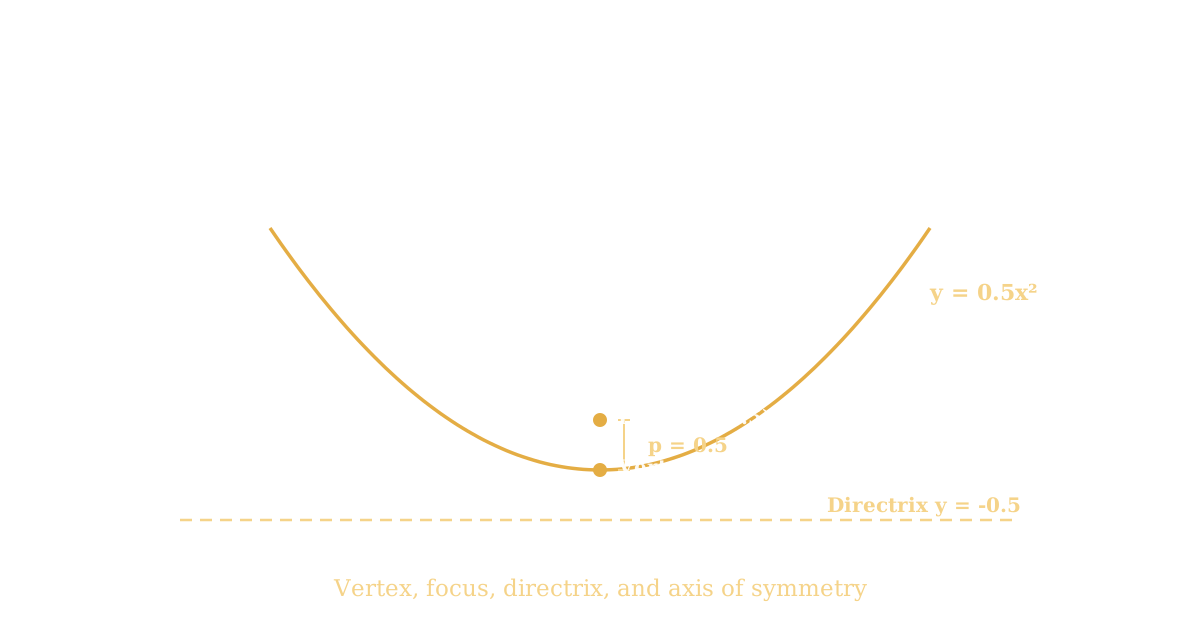
A curved distance differs from a straight-line distance. The straight line between (−2, 2) and (2, 2) is 4 units long, but the parabola dips down to its vertex at (0, 0) and back up, so the arc is longer: 5.915771430 units, about 47.9% longer than the chord. That extra length is the whole reason arc length needs its own calculation.
A complete parabola has infinite length, because the curve runs on forever in both directions and never closes. Only a finite arc between two finite coordinates has a calculable length, and that is what this calculator measures.
Parabola Arc Length Formula
The arc length of a function y = f(x) between x1 and x2 is given by a definite integral:
Each symbol in the formula has a precise meaning:
| Symbol | Meaning | Notes |
|---|---|---|
| L | Arc length | The curved distance along the parabola |
| x1, x2 | Interval endpoints | Start and end x values for a vertical parabola |
| dy/dx | Derivative | The slope of the tangent at each point |
| dx | Differential width | An infinitesimal step along the x axis |
| ds | Differential arc length | ds = √(1 + (dy/dx)2) dx |
For a vertical parabola y = a(x − h)2 + k, the derivative is dy/dx = 2a(x − h), so the integral becomes:
This integral has an exact closed-form answer, which is rare for arc-length problems. With u = 2a(x − h) and F(u) = ½[u√(1 + u2) + asinh(u)], the length is L = |F(u2) − F(u1)| / (2|a|), where asinh is the inverse hyperbolic sine. The calculator uses this exact formula, then cross-checks it with numerical integration.
For a horizontal parabola x = a(y − k)2 + h, the same formula applies with the roles of x and y swapped: integrate over y, and use dx/dy = 2a(y − k) instead of dy/dx.
How to Calculate the Arc Length of a Parabola
Calculating a parabola arc length by hand follows eight steps. The worked example below uses y = x2 from x = 0 to x = 3.
- Identify the parabola equation. y = x2, so a = 1, h = 0, k = 0.
- Identify the orientation. The equation gives y as a function of x, so it is a vertical parabola and the interval is in x.
- Find the derivative. dy/dx = 2x.
- Identify the interval. x1 = 0 and x2 = 3.
- Substitute into the arc-length formula. L = ∫03 √(1 + (2x)2) dx = ∫03 √(1 + 4x2) dx.
- Apply the antiderivative. With u = 2x, F(u) = ½[u√(1 + u2) + asinh(u)], and L = |F(6) − F(0)| / 2.
- Evaluate the limits. F(0) = 0. F(6) = ½[6√(37) + asinh(6)] = ½[36.4965751818 + 2.4917798526] = 19.4941775172. So L = 19.4941775172 / 2 = 9.7470887586.
- Interpret the final answer. L ≈ 9.747088759 units. The endpoints are (0, 0) and (3, 9), and the chord between them is 9.4868329805 units, so the arc exceeds the chord by only 0.2602557781 units, about 2.7%.
The same eight steps work for every form. A general quadratic y = ax2 + bx + c has derivative 2ax + b, so set u = 2ax + b and use the same F(u). A focus-form equation (x − h)2 = 4p(y − k) converts to vertex form with a = 1/(4p) first. A horizontal parabola swaps x and y throughout.
Parabola Equation Forms Explained
The same parabola can be written in several forms, and each form is convenient for a different job. The calculator accepts all five, so you can enter the equation exactly as your textbook or your measurements give it.
| Form | Equation | Best for |
|---|---|---|
| Vertical vertex form | y = a(x − h)2 + k | Reading the vertex (h, k) and the opening direction at a glance |
| Vertical general form | y = ax2 + bx + c | Equations as they come from data fitting or algebra problems |
| Horizontal vertex form | x = a(y − k)2 + h | Sideways parabolas, such as a dish viewed from the side |
| Horizontal general form | x = ay2 + by + c | Sideways parabolas in expanded form |
| Standard focus form | (x − h)2 = 4p(y − k) | Optics and reflector design, where the focus matters most |
The forms convert into each other by completing the square. For y = 2x2 − 4x + 1, factor out a = 2: y = 2(x2 − 2x) + 1 = 2(x − 1)2 − 1, so the vertex is (1, −1). In general, the vertex of y = ax2 + bx + c is at h = −b/(2a) and k = c − b2/(4a). The focus parameter is p = 1/(4a), so focus form follows directly: (x − 1)2 = 4 × (1/8)(y + 1), since p = 1/8 for a = 2.
One conversion trap to avoid: the vertex (h, k) in vertex form is not the same pair of numbers as the constants in general form. In y = 2x2 − 4x + 1, the constant c = 1 is the y-intercept, while the vertex sits at y = −1. Mixing the two up gives a different parabola and a wrong arc length.
Understanding the Vertex, Focus and Directrix
Three features define a parabola completely: the vertex, the focus, and the directrix.
The vertex is the turning point of the curve, where it changes direction. For y = a(x − h)2 + k it is the point (h, k). For y = 0.5x2 the vertex is (0, 0); for y = 2x2 − 4x + 1 it is (1, −1).
The focus is the fixed point that, together with the directrix, defines the curve. Every point on the parabola is exactly as far from the focus as from the directrix. For a vertical parabola the focus sits on the axis of symmetry at a distance p from the vertex, where p = 1/(4a). For y = 0.5x2, p = 0.5, so the focus is (0, 0.5).
The directrix is the fixed line on the opposite side of the vertex from the focus. For a vertical parabola it is the horizontal line y = k − p. For y = 0.5x2 it is y = −0.5. For a horizontal parabola the directrix is vertical: x = h − p.
The axis of symmetry is the line through the vertex and the focus. A vertical parabola is symmetric about the vertical line x = h; a horizontal one about the horizontal line y = k. The sign of a decides the opening direction: a > 0 opens upward (or right for a horizontal parabola), a < 0 opens downward (or left).
Here are the features of the five preset examples, all computed by the calculator:
| Example | Vertex | Focus | Directrix |
|---|---|---|---|
| y = 0.5x2 | (0, 0) | (0, 0.5) | y = −0.5 |
| y = x2 | (0, 0) | (0, 0.25) | y = −0.25 |
| x = 0.25(y − 1)2 + 2 | (2, 1) | (3, 1) | x = 1 |
| y = 2x2 − 4x + 1 | (1, −1) | (1, −0.875) | y = −1.125 |
| y = −0.5x2 + 3 | (0, 3) | (0, 2.5) | y = 3.5 |
Notice that a narrower parabola has its focus closer to the vertex: y = x2 has p = 0.25, while the wider y = 0.5x2 has p = 0.5. A wide, gentle curve needs a distant focus; a tight curve needs a close one.
Why Does Parabola Arc Length Require Integration?
A straight line has one slope, so its length is one multiplication. A parabola changes slope at every point, so no single multiplication can give its length. The only honest way to measure it is to cut the curve into tiny pieces, measure each piece as if it were straight, and add them up. That adding-up is integration.
Look at one tiny piece. Moving a small horizontal distance dx along the curve also moves a small vertical distance dy, and the piece itself is the hypotenuse of that tiny right triangle:
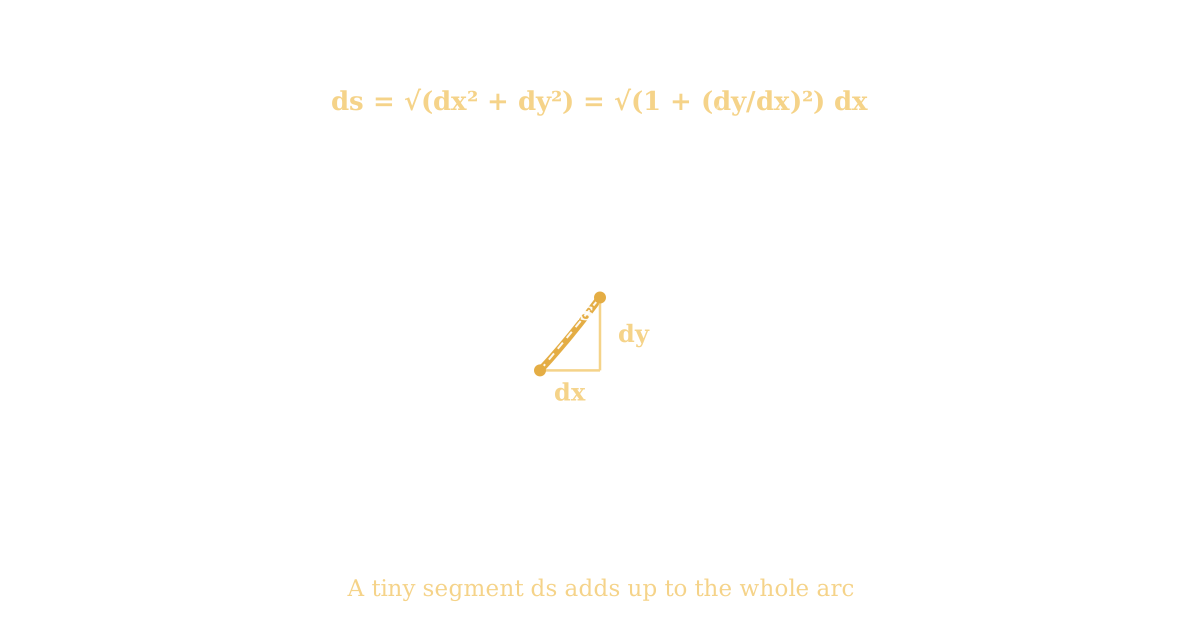
The slope dy/dx is what makes each piece longer than dx alone. Where the parabola is flat, near its vertex, dy/dx is close to zero and ds is barely longer than dx. Where the parabola is steep, dy/dx is large and each piece is much longer than dx. For y = x2 from 0 to 3, the slope grows from 0 at the vertex to 6 at x = 3, which is why the arc (9.747088759) is only slightly longer than the chord (9.4868329805) even though the curve climbs 9 units: most of the climb happens where the curve is already steep, and steep pieces contribute mostly vertical length that the chord already covers.
Unlike the ellipse, whose arc-length integral has no elementary antiderivative, the parabola integral does: the asinh formula in the formula section. The calculator uses that exact antiderivative as its primary method and checks it against adaptive numerical integration, so the answer is exact up to floating-point rounding, not an approximation.
Arc Length vs Chord Length
The arc length is the distance along the curve; the chord length is the straight-line distance between the two endpoints. The arc is always at least as long as the chord, and it equals the chord only when the segment is straight, which never happens on a parabola except for a zero-length arc.
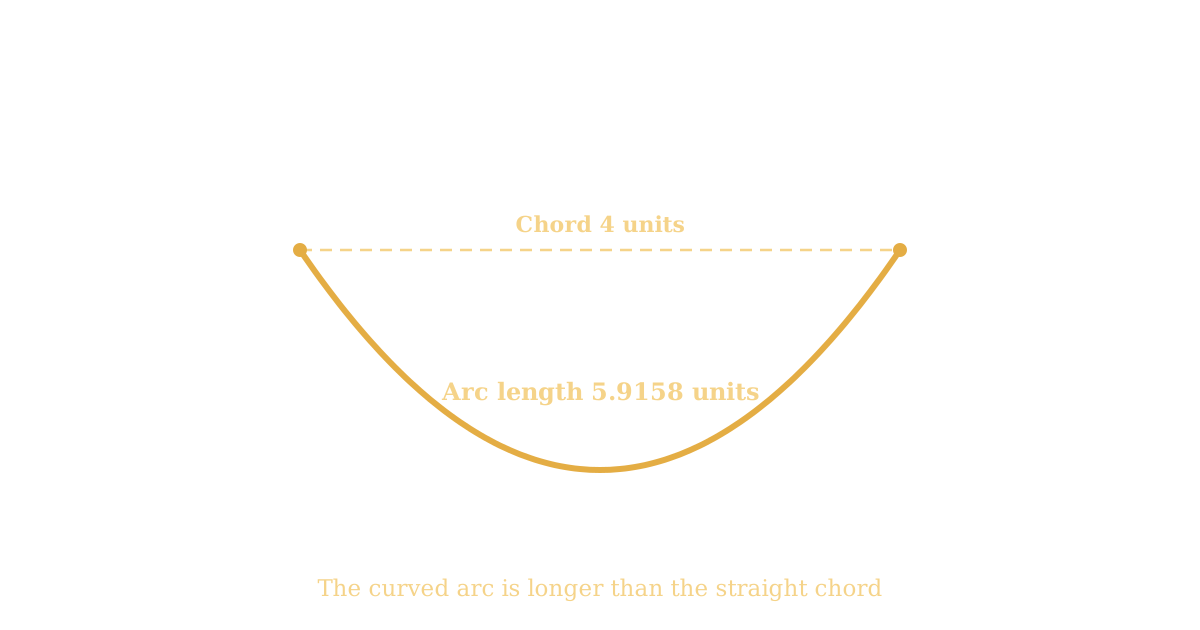
How much longer the arc is depends on how much the curve bends between the endpoints. The five preset examples show the full range:
| Example | Arc length | Chord | Excess | Arc / chord |
|---|---|---|---|---|
| y = 0.5x2, −2 to 2 | 5.915771430 | 4 | 47.89% | 1.4789 |
| y = x2, 0 to 3 | 9.747088759 | 9.4868329805 | 2.74% | 1.0274 |
| x = 0.25(y − 1)2 + 2, −1 to 3 | 4.591174299 | 4 | 14.78% | 1.1478 |
| y = 2x2 − 4x + 1, 0 to 2 | 4.646783762 | 2 | 132.34% | 2.3234 |
| y = −0.5x2 + 3, −2 to 2 | 5.915771430 | 4 | 47.89% | 1.4789 |
The fourth example is the striking one: the arc is more than twice the chord. The endpoints (0, 1) and (2, 1) are only 2 units apart, but the curve dives down to the vertex (1, −1) and back up, travelling 4.646783762 units to get there. Whenever an interval passes through the vertex, the arc bends sharply and the excess over the chord grows. The second example is the opposite: the interval starts at the vertex and climbs steadily, so the curve barely bends away from the chord and the excess is under 3%.
This comparison is why the calculator reports both numbers side by side. If you are cutting material, the arc length is the length to cut; the chord is only the gap the finished piece spans.
Vertical vs Horizontal Parabola
A vertical parabola opens up or down and is a function of x; a horizontal parabola opens left or right and is a function of y. The mathematics is identical with x and y swapped, but the setup is easy to get wrong, so keep the two cases side by side.
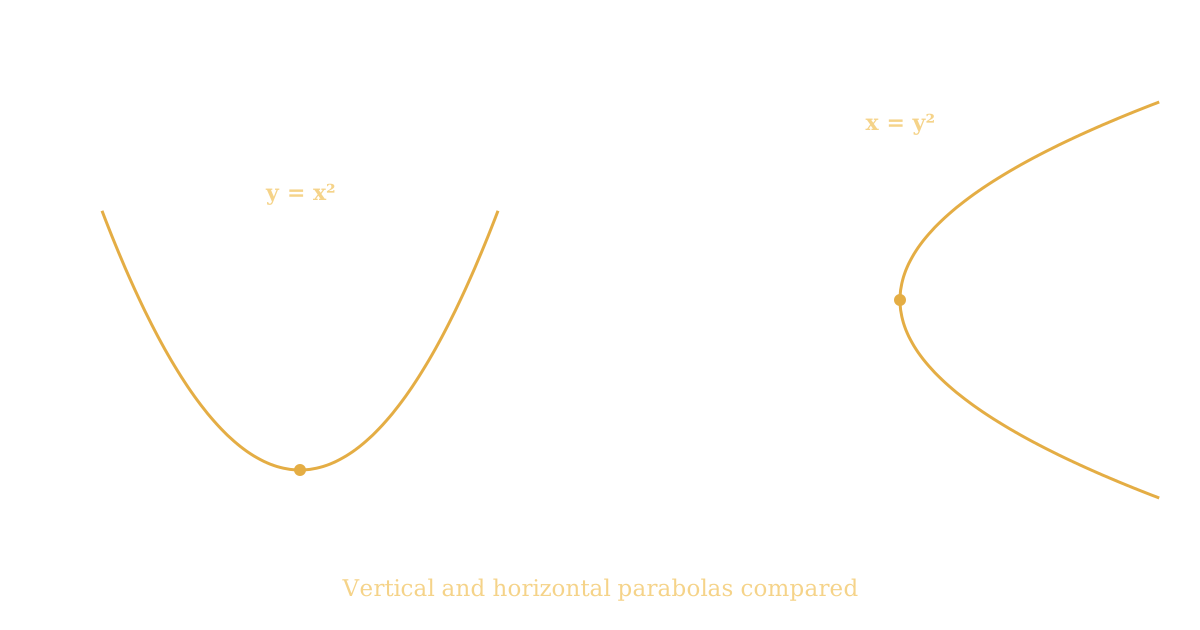
| Feature | Vertical parabola | Horizontal parabola |
|---|---|---|
| Equation | y = a(x − h)2 + k | x = a(y − k)2 + h |
| Independent variable | x | y |
| Interval | x1 to x2 | y1 to y2 |
| Derivative | dy/dx = 2a(x − h) | dx/dy = 2a(y − k) |
| Arc-length integral | L = ∫ √(1 + (dy/dx)2) dx | L = ∫ √(1 + (dx/dy)2) dy |
| Axis of symmetry | x = h (vertical line) | y = k (horizontal line) |
| Opens | Up if a > 0, down if a < 0 | Right if a > 0, left if a < 0 |
| Focus | (h, k + p) | (h + p, k) |
| Directrix | y = k − p | x = h − p |
The horizontal preset shows the swap in action: x = 0.25(y − 1)2 + 2 from y = −1 to y = 3 has arc length 4.591174299 units, with endpoints (3, −1) and (3, 3). The derivative is dx/dy = 0.5(y − 1), which is −1 at y = −1 and +1 at y = 3. If you mistakenly entered −1 and 3 as x values, the calculator would be solving a different problem on a different curve, so always check which variable your interval belongs to.
A useful symmetry check: rotating a vertical parabola by 90 degrees gives a horizontal one with the same arc lengths. The vertical y = 0.25x2 from x = −1 to x = 3 and the horizontal x = 0.25y2 from y = −1 to y = 3 have exactly the same arc length, because the curves are congruent.
What Happens When the Parabola Coefficient Changes?
The coefficient a is the single number that controls the shape of a parabola. Changing it changes the width, the steepness, the focus, and the arc length over any fixed interval.
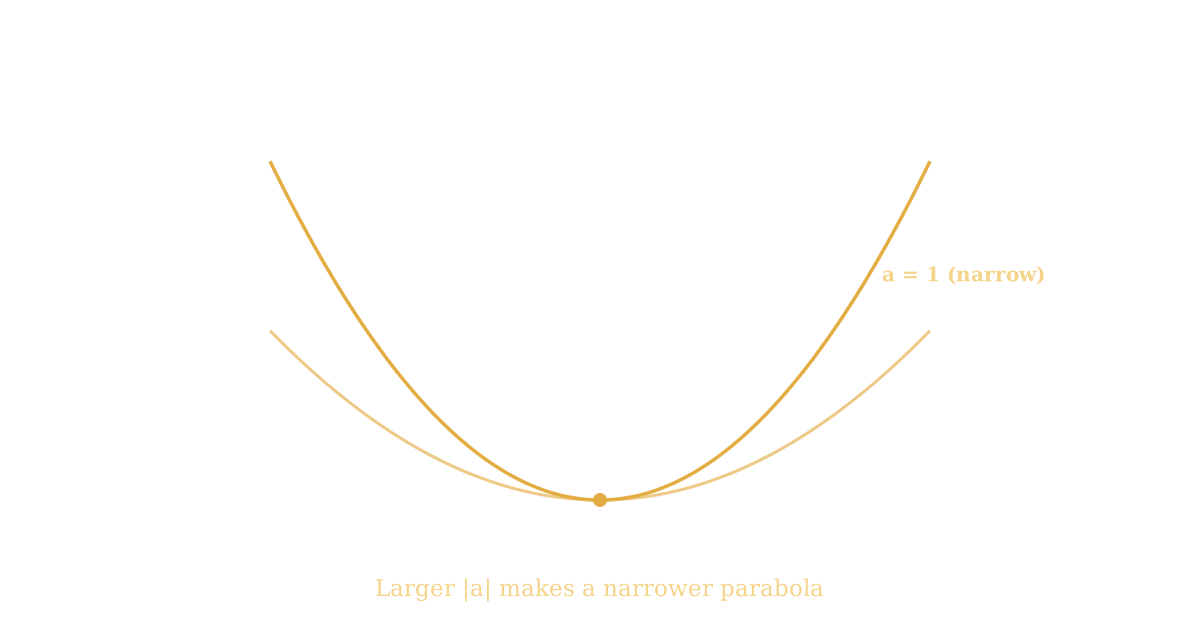
Larger |a| means a narrower parabola. With a = 1, y = x2 climbs to y = 4 by x = 2. With a = 0.25, y = 0.25x2 only reaches y = 1 at x = 2. The narrow curve bends harder, so its arc over the same interval is longer: y = x2 from 0 to 2 has arc length 4.646783762 units (the same shape as the fourth preset, shifted), while y = 0.25x2 from 0 to 2 has arc length 2.2955871494 units.
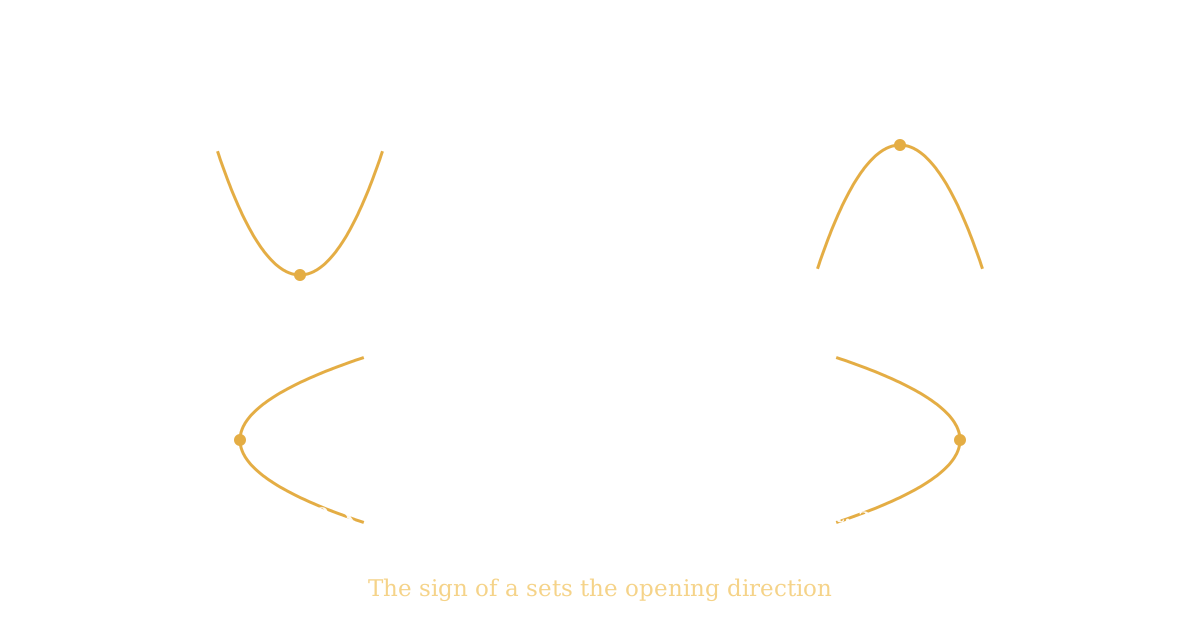
The sign of a flips the opening direction. y = 0.5x2 opens upward from its vertex at (0, 0); y = −0.5x2 + 3 opens downward from (0, 3). Flipping the sign mirrors the curve, so the arc length over a symmetric interval is unchanged: both give 5.915771430 units from −2 to 2. Only the endpoints and the tangent slopes change sign.
Changing a moves the focus. Since p = 1/(4a), doubling a halves the focal distance. For a = 0.25, p = 1 and the focus sits 1 unit from the vertex; for a = 1, p = 0.25 and the focus is a quarter unit away. This is why narrow dishes focus sharply and wide dishes focus gently.
Very small a is nearly a straight line. As a approaches 0, the parabola flattens toward the line y = k, and the arc length approaches the chord length. The calculator handles a = 0 in general form as the linear limiting case L = |x2 − x1|√(1 + b2), and it shows a validation message for a = 0 in vertex or focus form, where a zero coefficient is not a parabola at all.
Does a Parabola Have a Perimeter?
No. A complete parabola is an open, unbounded curve: it runs on forever in both directions and never closes back on itself. Its total length is infinite, so there is no finite number that could be called its perimeter.
This is different from a circle or an ellipse, which are closed curves with a measurable perimeter. It is also different from a parabola segment such as a satellite dish or an arch, which is a finite piece of a parabola cut off at two endpoints. That piece has a perfectly well-defined arc length, and that is the number this calculator returns.
The distinction matters in practice. If you ask for the length of a parabolic arch, you must say where the arch starts and ends: the arch y = −(1/3)x2 spanning x = −3 to x = 3 is a finite piece with a finite length, but the underlying parabola continues past both ends forever. Without endpoints, the question has no answer.
Two related mistakes follow from forgetting this. The first is asking the calculator for a whole-parabola length: it cannot give one, and any tool that claims to is wrong. The second is treating the chord as the perimeter of a closed shape: the chord plus the arc does enclose a region, and that region has a perimeter (arc plus chord), but that is the perimeter of the segment region, not of the parabola.
Worked Example: Arc from x = -2 to x = 2 on y = 0.5x²
This worked example shows every step of the exact calculation for the first preset, y = 0.5x2 from x = −2 to x = 2, so you can check the calculator by hand.
- Identify the equation. y = 0.5x2, so a = 0.5, h = 0, k = 0, and the vertex is (0, 0).
- Find the derivative. dy/dx = 2ax = x.
- Set up the integral. L = ∫−22 √(1 + x2) dx.
- Substitute u = 2a(x − h) = x. Then u1 = −2 and u2 = 2, and L = |F(2) − F(−2)| / (2 × 0.5) = |F(2) − F(−2)|.
- Evaluate F(u) = ½[u√(1 + u2) + asinh(u)]. At u = 2: √(5) ≈ 2.2360679775, so 2√(5) ≈ 4.4721359550, and asinh(2) ≈ 1.4436354752. Their sum is 5.9157714302, and half of it is F(2) ≈ 2.9578857151.
- Use symmetry. F is an odd function, so F(−2) = −2.9578857151. The difference F(2) − F(−2) = 5.9157714302.
- Divide by 2|a| = 1. L = 5.9157714302 / 1 = 5.9157714302, so L ≈ 5.915771430 units.
- Check against the chord. The endpoints are (−2, 2) and (2, 2), so the chord is 4 units. The arc exceeds it by 1.9157714302 units, or 47.894286%.
By symmetry, half of this arc is the arc from 0 to 2: y = 0.5x2 from x = 0 to x = 2 has length 2.9578857151 units, exactly half of 5.9157714302. Symmetry checks like this are the fastest way to catch a wrong answer: if the two halves of a symmetric arc do not match, something is wrong.
The downward-opening twin, y = −0.5x2 + 3 from x = −2 to x = 2, has the same arc length, 5.915771430 units, because mirroring the curve does not change distances. Its endpoints are (−2, 1) and (2, 1), its vertex is (0, 3), and its tangent slopes are +2 at x = −2 and −2 at x = 2.
Practical Applications of Parabola Arc Length
Parabola arc length is a working number in engineering and design, not just a textbook exercise. Whenever a parabolic curve is built, cut, or measured, someone needs its length.
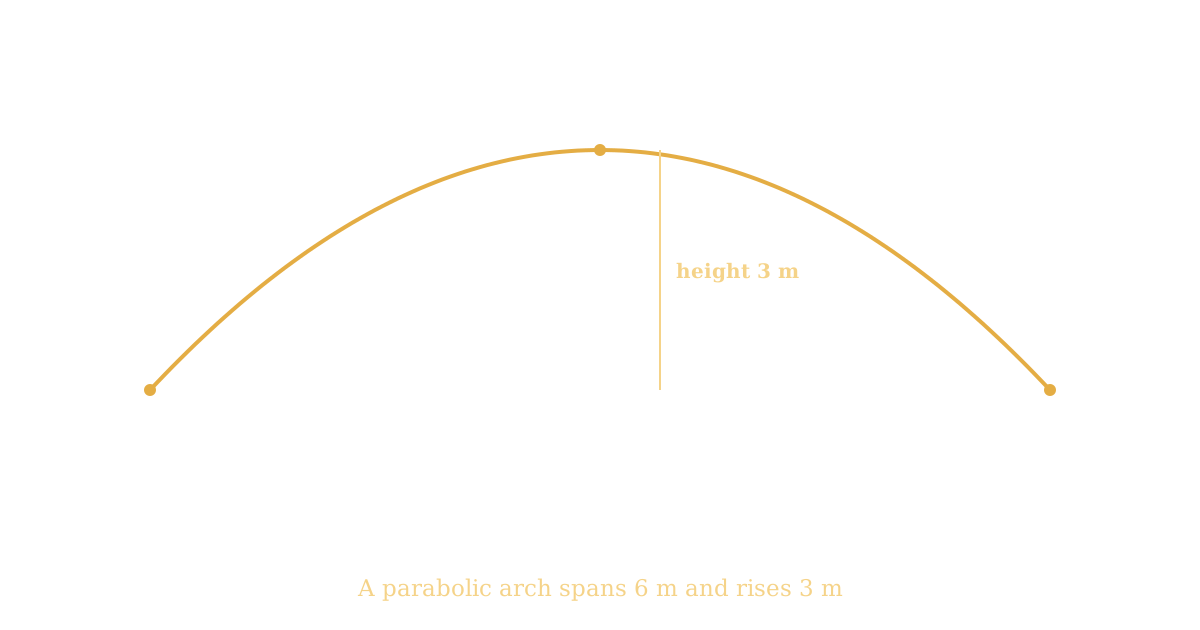
Architectural arches and bridges. A parabolic arch carries its load evenly to its supports, which is why the shape appears in bridges and vaults. Knowing the arc length tells the builder how much stone, steel, or concrete the arch needs. The arch in the diagram, y = −(1/3)x2 with a 6 m span and a 3 m rise, is a finite piece of a parabola: its length is the material length, and the chord is only the span it covers.
Reflectors and satellite dishes. A parabolic dish reflects incoming signals to its focus, and a car headlight reflector sends light from its focus out in parallel rays. The dish surface is a paraboloid, and its profile is a parabola arc: the arc length sets the size of the sheet that must be cut and shaped.
Road and railway design. Vertical curves on roads, where a gradient changes, are often parabolic, because a parabola gives a smooth, constant rate of change of gradient. The arc length of the curve is the length of road surface to pave and mark.
Projectile motion. A thrown ball follows a parabola (ignoring air resistance). The arc length of its flight path is the actual distance travelled, which is longer than the straight-line distance from launch to landing, and it matters when estimating flight time or energy.
CAD modelling and manufacturing. Curved parts are often specified as parabola segments. The arc length drives tool paths, cutting lengths, and cost estimates: the machine cuts along the arc, not along the chord.
Physics and geometry education. The parabola is the first curve where the arc-length integral has an exact closed-form answer, which makes it the standard teaching example for the asinh antiderivative and for the difference between an integral that can be done exactly and one, like the ellipse, that cannot.
Avoid claiming that every curved structure is mathematically parabolic. Many arches are circular or catenary; only a structure designed to the parabola equation has a parabolic arc length.
Common Mistakes When Calculating Parabola Arc Length
These ten mistakes account for most wrong answers. Check your work against them before trusting a result.
- Using chord length instead of arc length. The straight line between the endpoints is always shorter. For y = 2x2 − 4x + 1 from 0 to 2, the chord is 2 but the arc is 4.646783762, more than double.
- Forgetting to differentiate the equation. The formula needs (dy/dx)2 inside the square root. Leaving it out gives the interval length |x2 − x1|, which is the horizontal distance, not the arc.
- Using the wrong integration limits. The limits are the independent variable: x values for a vertical parabola, y values for a horizontal one. Swapping them integrates over the wrong variable.
- Confusing vertex form with general form. In y = 2x2 − 4x + 1, the vertex is (1, −1), not (0, 1). The constant c = 1 is the y-intercept.
- Using a horizontal equation as a vertical equation. x = 0.25(y − 1)2 + 2 is a function of y. Treating −1 and 3 as x values solves a different problem.
- Ignoring negative coefficients. A negative a flips the opening direction and changes the endpoints, the focus, and the tangent slopes, even though the arc length over a symmetric interval stays the same.
- Confusing full coordinates with vertex-relative coordinates. In y = a(x − h)2 + k, the interval is in absolute x, not in (x − h). Substituting (x − h) limits into the integral double-counts the shift.
- Using an incorrect focus parameter. p = 1/(4a), not 1/a or 4a. For a = 2, p = 1/8 = 0.125, and the focus of y = 2x2 − 4x + 1 is (1, −0.875), not (1, −0.5).
- Assuming a parabola has a finite complete perimeter. It does not: the curve is unbounded and its total length is infinite. Only finite arcs have finite lengths.
- Rounding intermediate values too early. Round only the final answer. In the worked example, rounding √(5) to 2.24 before finishing shifts the final result in the fourth decimal place.
Quick Reference: Common Parabola Configurations
These verified values are useful for checking your own calculations or for a quick estimate before you run the calculator.
| Configuration | Interval | Arc length | Chord |
|---|---|---|---|
| y = x2 | x = 0 to 1 | 1.4789428575 | 1.4142135624 |
| y = 0.5x2 | x = 0 to 2 | 2.9578857151 | 2.8284271247 |
| y = 0.5x2 | x = −2 to 2 | 5.915771430 | 4 |
| y = x2 | x = 0 to 3 | 9.747088759 | 9.4868329805 |
| y = 2x2 − 4x + 1 | x = 0 to 2 | 4.646783762 | 2 |
| x = 0.25(y − 1)2 + 2 | y = −1 to 3 | 4.591174299 | 4 |
| y = −0.5x2 + 3 | x = −2 to 2 | 5.915771430 | 4 |
Two patterns are worth remembering. First, y = x2 from 0 to 1 gives 1.4789428575, the same number as the arc-to-chord ratio of the symmetric y = 0.5x2 arc: a coincidence of the numbers, not a general rule. Second, the chord for y = 0.5x2 from 0 to 2 is 2.8284271247, which is 2√(2): the endpoints (0, 0) and (2, 2) are 2 units apart in both x and y.
Parabola Arc Length Formula Reference
Keep this reference card handy. All angles are in radians where angles appear; parabola formulas use coordinates directly, so no angle conversion is needed.
The general-form vertex conversion and the focus parameter are the two formulas most often looked up, so they are listed separately. The calculator applies all of them automatically; this card is for checking its work by hand.
Parabola Arc Length FAQs
How do you calculate the arc length of a parabola? +
Enter the parabola equation and the start and end coordinates, then evaluate L = ∫ √(1 + (dy/dx)<sup>2</sup>) dx between them. For y = x<sup>2</sup> from x = 0 to x = 3, the derivative is 2x, the integral is ∫<sub>0</sub><sup>3</sup> √(1 + 4x<sup>2</sup>) dx, and the result is 9.747088759 units. The calculator on this page does the same calculation for any of the five equation forms.
What is the formula for parabola arc length? +
The general formula is L = ∫<sub>x<sub>1</sub></sub><sup>x<sub>2</sub></sup> √(1 + (dy/dx)<sup>2</sup>) dx. For a vertical parabola y = a(x − h)<sup>2</sup> + k it has an exact closed form: with u = 2a(x − h) and F(u) = ½[u√(1 + u<sup>2</sup>) + asinh(u)], the length is L = |F(u<sub>2</sub>) − F(u<sub>1</sub>)| / (2|a|). For a horizontal parabola, swap x and y and use dx/dy instead of dy/dx.
Can parabola arc length be calculated exactly? +
Yes. Unlike the ellipse, whose arc-length integral has no elementary antiderivative, the parabola integral evaluates exactly through the inverse hyperbolic sine, asinh. The calculator uses that exact closed form and cross-checks it with adaptive numerical integration. The only error is floating-point rounding, far below the displayed precision.
Why is integration used to calculate arc length? +
Because the slope of a parabola changes at every point, so no single multiplication can give the length. Integration cuts the curve into tiny pieces of length ds = √(dx<sup>2</sup> + dy<sup>2</sup>) and adds them up. Each piece is nearly straight, and the sum of all the pieces is the arc length.
What is the difference between arc length and chord length? +
Arc length is the distance along the curve; chord length is the straight-line distance between the endpoints. The arc is always at least as long as the chord. For y = 0.5x<sup>2</sup> from −2 to 2, the arc is 5.915771430 units and the chord is 4 units, so the arc is 47.89% longer. For y = 2x<sup>2</sup> − 4x + 1 from 0 to 2, the arc is 4.646783762 and the chord is only 2, so the arc is 132.34% longer.
Can I calculate the arc length between any two points? +
Yes, as long as both points lie on the same parabola and you give their coordinates in the independent variable: x values for a vertical parabola, y values for a horizontal one. The calculator finds the full coordinates of both endpoints from the equation, so you only enter the interval. If the two coordinates are equal, the arc length is zero.
Can this calculator handle horizontal parabolas? +
Yes. Choose horizontal vertex form x = a(y − k)<sup>2</sup> + h, horizontal general form x = ay<sup>2</sup> + by + c, or horizontal focus form, then enter a y interval. For example, x = 0.25(y − 1)<sup>2</sup> + 2 from y = −1 to y = 3 gives 4.591174299 units, with endpoints (3, −1) and (3, 3). Derivatives are labelled dx/dy for horizontal parabolas, not dy/dx.
What is the difference between vertex form and standard form? +
Vertex form y = a(x − h)<sup>2</sup> + k shows the vertex (h, k) directly. General form y = ax<sup>2</sup> + bx + c hides the vertex, which sits at h = −b/(2a) and k = c − b<sup>2</sup>/(4a). Standard focus form (x − h)<sup>2</sup> = 4p(y − k) shows the focus parameter p, with a = 1/(4p). All three describe the same curve; the calculator converts between them automatically.
How does coefficient a affect the parabola? +
The magnitude |a| controls the width: larger |a| makes a narrower, steeper parabola, and a longer arc over the same interval. The sign controls the opening direction: a > 0 opens upward (or right for a horizontal parabola) and a < 0 opens downward (or left). The focus distance p = 1/(4a) shrinks as |a| grows, so narrow parabolas focus sharply.
What are the vertex, focus and directrix? +
The vertex is the turning point of the parabola, (h, k) in vertex form. The focus is a fixed point on the axis of symmetry at distance p = 1/(4a) from the vertex; for y = 0.5x<sup>2</sup> it is (0, 0.5). The directrix is a fixed line on the opposite side of the vertex, y = k − p for a vertical parabola; for y = 0.5x<sup>2</sup> it is y = −0.5. Every point on the parabola is equally distant from the focus and the directrix.
Does a complete parabola have a finite perimeter? +
No. A parabola is an open, unbounded curve that runs on forever in both directions, so its total length is infinite. Only a finite arc between two finite coordinates has a calculable length. This calculator reports only the selected finite arc and never a complete perimeter.
Can a downward-opening parabola have an arc length? +
Yes. Arc length depends on distances, not on direction, so flipping a parabola upside down changes nothing about its length. y = −0.5x<sup>2</sup> + 3 from x = −2 to x = 2 has arc length 5.915771430 units, exactly the same as the upward-opening y = 0.5x<sup>2</sup> over the same interval. Only the endpoints, the vertex, and the tangent slopes differ.
What is the inverse hyperbolic sine function? +
The inverse hyperbolic sine, asinh(u), is the inverse of sinh(u) = (e<sup>u</sup> − e<sup>−u</sup>)/2. It can be computed as asinh(u) = ln(u + √(u<sup>2</sup> + 1)). It appears in the parabola arc-length antiderivative F(u) = ½[u√(1 + u<sup>2</sup>) + asinh(u)]. For example, asinh(2) ≈ 1.4436354752 and asinh(6) ≈ 2.4917798526.
Is the arc length always longer than the straight-line distance? +
Yes, except when the two endpoints coincide, in which case both are zero. A curve between two points is always at least as long as the straight line joining them, and on a parabola the curve always bends away from the chord, so the arc is strictly longer. The excess can be small, under 3% for y = x<sup>2</sup> from 0 to 3, or large, over 132% for y = 2x<sup>2</sup> − 4x + 1 from 0 to 2.