Circle Arc Length Calculator
Find any circle arc length from radius, diameter, or angle, instantly.
Original Curve & Selected Arc
Gold dots mark the midpoint of each subinterval.
Integrand g(x) & Midpoint Rectangles
Hover a rectangle for its subinterval, midpoint, integrand value and contribution.
Detailed Midpoint Calculation Table
Convergence Comparison
Differences between successive refinements are a practical error indicator, not a guaranteed error bound.
Calculation Error
Section Navigation
How to Use the Circle Arc Length Calculator
The Circle Arc Length Calculator measures the curved distance along any part of a circle, from a small slice to the complete circumference. It accepts six different starting measurements, so you can use whichever value you already have. Follow these steps to get a correct answer in under a minute.
- Choose the input method. Pick Radius, Diameter, Full Circle Circumference, Chord Length, Full Circle Area, or Sector Area. The input field, its label, and its unit list change to match the method you pick.
- Enter your measurement. Type the value in the input box. For area methods, use the squared unit list (mm², cm², m², km², in², ft², yd²).
- Enter the central angle. Type the angle in degrees or radians using the DEG/RAD toggle, or drag the angle slider from 0° to 360°. The live diagram and the result update as you move it.
- Set the start and end angles if you need them. The default sweep starts at 0° and runs counterclockwise. Change the start angle, end angle, or direction to measure an arc anywhere on the circle. The sweep, not the position, decides the arc length.
- Choose input and output units. The calculator converts your input into a consistent internal unit, calculates, then converts the answer into your output unit. The number changes with the unit; the length does not.
- Pick a precision. Choose 2, 4, 6, or 8 decimal places. The default is 4. The calculator always uses full-precision π internally and rounds only the displayed result.
- Click Calculate Now. The main result is the selected arc length, with its classification: zero-length arc, minor arc, semicircle, major arc, or complete circle. Below it you get the radius, diameter, complete circumference, complementary arc, chord length, sector area, circular segment area, arc percentage, both angle forms, and the arc-to-chord ratio.
- Explore the diagram. The live circle diagram draws the full circle, highlights the selected arc in gold, and marks the centre O, the radius lines, the chord, and the endpoints. Use the toggles to show or hide the radius, diameter, chord, centre point, angle marker, and the minor and major arcs.
- Copy, print, or reset. Use Copy Result to place the answer on your clipboard, Print Summary for a simple report, or Reset to clear the panel. The preset buttons load verified examples instantly.
Try an example. Radius 5 with a 60° angle gives an arc of 5.2359877560 units. Radius 8 with 90° gives 12.5663706144 units. Radius 4 with 270° gives a major arc of 18.8495559215 units. Diameter 14 with 120° gives 14.6607657168 units. Radius 10 with 180° gives the semicircle arc 31.4159265359 units, and radius 6 with 360° gives the full circumference 37.6991118431 units.
Important tips. Keep the angle unit consistent: 60° and 1.0471975512 radians are the same angle, but 60 radians is not 60°. Arc length is the curved distance only; the chord is a different measurement and is always shorter, except for a zero-length arc. If you enter a diameter, the calculator halves it to find the radius first. A zero or negative measurement is not a valid circle, so the calculator rejects it instead of showing a misleading answer.
What Is Circle Arc Length?
A circle is the set of all points at a fixed distance, the radius, from a centre point O. An arc is a continuous part of the circle between two points on it. The arc length is the distance you would travel if you walked along the curve from one endpoint to the other, staying on the circle the whole way.
Picture a circular running track. The arc length is the distance along the lane between two gates. The straight line cutting across the infield between the same two gates is the chord, and it is shorter. The difference matters: a runner follows the curve, so the curved distance is the one that counts.
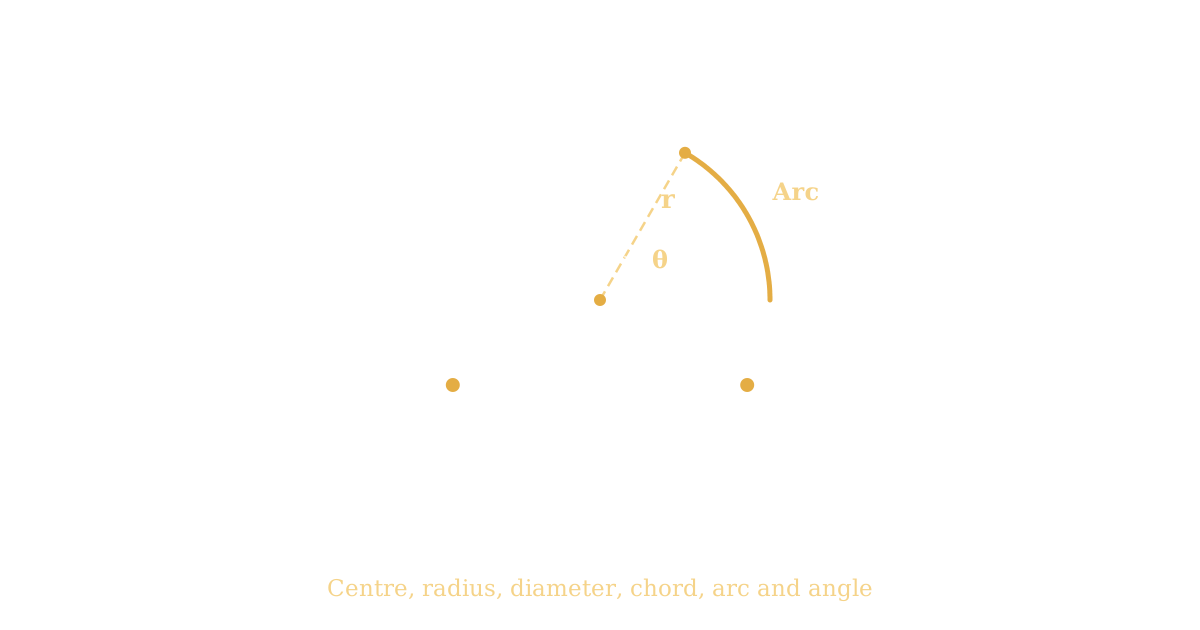
Every circle has the same parts, scaled by its radius. The centre O is the fixed point. The radius r runs from O to any point on the circle. The diameter d runs from one side to the other through O, and it is always twice the radius. The circumference C is the distance all the way around, C = 2πr. The central angle θ is the angle at O between the two radii that run to the arc endpoints, and it decides what fraction of the circumference the arc covers.
Two points on a circle always create two arcs: the shorter one, the minor arc, and the longer one, the major arc. Together they make the complete circumference. Which one you want depends on your problem, and the calculator shows both, so you never have to guess.
Arc length is a one-dimensional measurement, a length, so it is reported in plain units such as cm, m, or inches. It is not an area, and it is not an angle. Keeping those three quantities separate is the first step to getting every circle calculation right.
Circle Arc Length Formula
The arc length of a circle comes straight from the circumference of a full circle. The circumference of a complete circle is:
A central angle represents a fraction of a complete 360° rotation. An arc with central angle θ covers the fraction θ / 360 of the whole circle, so:
Simplifying gives the degree form of the formula:
When the angle is measured in radians, the formula is simpler still, because a radian is defined by the radius itself:
Each symbol in the formulas has a precise meaning:
| Symbol | Meaning | Notes |
|---|---|---|
| L | Arc length | The curved distance along the arc |
| r | Radius | Distance from the centre to the arc |
| d | Diameter | d = 2r, the full width of the circle |
| θ | Central angle | In degrees (0° to 360°) or radians (0 to 2π) |
| π | Pi | 3.141592653589793, the circle constant |
| C | Circumference | C = 2πr, the arc of a complete circle |
Both forms give the same answer. Use L = πrθ / 180 when your angle is in degrees, and L = rθ when it is in radians. The calculator converts degrees to radians first and then uses L = rθ internally, which is why the two modes always agree.
Using the diameter instead of the radius gives a second form of the same formula. Since d = 2r, then r = d / 2, and substituting gives L = dθ / 2 in radians, or L = πdθ / 360 in degrees.
How to Calculate Arc Length Using Radius
Radius plus central angle is the most direct way to find an arc length. The worked example below uses a radius of 5 units and a central angle of 60°.
- Identify the radius. r = 5 units.
- Identify the central angle. θ = 60°.
- Convert degrees to radians. θ = 60 × π / 180 = π / 3 = 1.0471975512 radians.
- Write the arc-length formula. L = rθ.
- Substitute the values. L = 5 × π / 3.
- Calculate. L = 5.2359877560 units.
- Round as needed. To two decimal places, L = 5.24 units.
The same steps work for any radius and angle. A radius of 8 units with 90° gives L = 8 × π / 2 = 12.5663706144 units. A radius of 3 units with 60° gives L = 3 × π / 3 = 3.1415926536 units. A radius of 1 unit with 60° gives L = 1.0471975512 units, which is exactly π / 3, a useful check: for r = 1, the arc length equals the angle in radians.
Rounding rule. Round only at the end. If you replace π with 3.14 before multiplying, a radius of 5 with 60° gives 5.2333333333 instead of 5.2359877560, an error of 0.0026544227. That error grows with the radius, so keep full precision through the calculation and round only the final displayed result.
How to Calculate Arc Length Using Diameter
When you know the diameter instead of the radius, halve it first, then apply the same formula. The worked example below uses a diameter of 14 units and a central angle of 120°.
- Identify the diameter. d = 14 units.
- Find the radius. r = d / 2 = 14 / 2 = 7 units.
- Identify the central angle. θ = 120° = 2π / 3 = 2.0943951024 radians.
- Write the formula. L = rθ, or directly L = πdθ / 360.
- Substitute. L = 7 × 2.0943951024, or L = π × 14 × 120 / 360.
- Calculate. L = 14.6607657168 units.
- Round as needed. To two decimal places, L = 14.66 units.
Both routes agree exactly, which is a good self-check. The radius route gives 7 × 2.0943951024 = 14.6607657168. The diameter route gives π × 14 × 120 / 360 = 14.6607657168. If the two disagree, the diameter was not halved correctly.
Another example: a diameter of 20 units with 180° gives r = 10 units, so L = π × 10 = 31.4159265359 units, the semicircle arc. A diameter of 10 units with 60° gives r = 5 units, so L = 5.2359877560 units. The most common error in this calculation is forgetting the division by two and using the diameter as if it were the radius, which doubles the answer. For d = 14, that mistake gives 29.3215314336 instead of 14.6607657168.
Measuring tip. Diameters are often easier to measure in real life than radii, because you can measure straight across the circle. That is why the calculator accepts diameter input directly: measure across, enter it, and the calculator halves it for you.
How to Calculate Arc Length in Degrees
Degrees are the everyday unit for angles. A complete circle contains 360°, so a central angle in degrees tells you directly what fraction of the full circle your arc covers. An angle of 90° covers one quarter of the circle, 180° covers one half, and 270° covers three quarters.
The degree formula is L = πrθ / 180, where θ is in degrees. It comes from the fraction idea: θ / 360 of the circumference 2πr, simplified.
Worked example. Radius 8 units, angle 90°.
- Identify the values. r = 8 units, θ = 90°.
- Find the fraction of the circle. 90 / 360 = 1 / 4, a quarter circle.
- Write the formula. L = πrθ / 180.
- Substitute. L = π × 8 × 90 / 180 = π × 8 / 2.
- Calculate. L = 12.5663706144 units.
- Check against the circumference. The full circumference is 2π × 8 = 50.2654824574 units, and one quarter of it is 50.2654824574 / 4 = 12.5663706144 units. The two agree.
More degree examples with a radius of 5 units: 30° gives L = 2.6179938780 units, 45° gives L = 3.9269908170 units, 120° gives L = 10.4719755120 units, and 270° gives L = 23.5619449019 units. Notice that doubling the angle doubles the arc length for the same radius, because arc length is directly proportional to the central angle.
Common degree mistake. Putting a degree value straight into L = rθ without converting gives a wildly wrong answer. For r = 5 and 60°, the unconverted calculation gives 5 × 60 = 300, but the correct answer is 5.2359877560. The formula L = rθ needs radians, so either convert first or use the degree form L = πrθ / 180.
How to Calculate Arc Length in Radians
A radian is the angle you get when the arc length equals the radius. If you wrap a length of string equal to the radius around the circle, the angle it subtends at the centre is exactly 1 radian. A complete circle contains 2π radians, about 6.2831853072 radians, because the full circumference is 2πr and dividing by r leaves 2π.
The radian formula is L = rθ, the simplest arc-length formula there is. It has no π in it, because the π is already inside the radian measure of the angle.
Worked example. Radius 5 units, angle π / 3 radians (which is 60°).
- Identify the values. r = 5 units, θ = π / 3 = 1.0471975512 radians.
- Write the formula. L = rθ.
- Substitute. L = 5 × 1.0471975512.
- Calculate. L = 5.2359877560 units.
- Check against degrees. π / 3 radians is 60°, and the degree formula gives L = π × 5 × 60 / 180 = 5.2359877560 units. The two agree exactly.
More radian examples: a radius of 4 units with θ = π / 2 radians gives L = 4 × 1.5707963268 = 6.2831853072 units. A radius of 6 units with θ = π / 4 radians gives L = 6 × 0.7853981634 = 4.7123889804 units. A radius of 10 units with θ = π radians gives L = 10 × 3.1415926536 = 31.4159265359 units, the semicircle arc.
Why radians are preferred in mathematics. Calculus formulas for arc length, and the formulas for chord, sector, and segment area on this page, all use radians. Degrees are convenient for everyday measurement, but radians make the mathematics clean, which is why the calculator converts every angle to radians before it calculates.
Minor Arc vs Major Arc
Two points on a circle divide it into two arcs. The shorter one is the minor arc, and the longer one is the major arc. They share the same endpoints, and together they make the complete circumference.
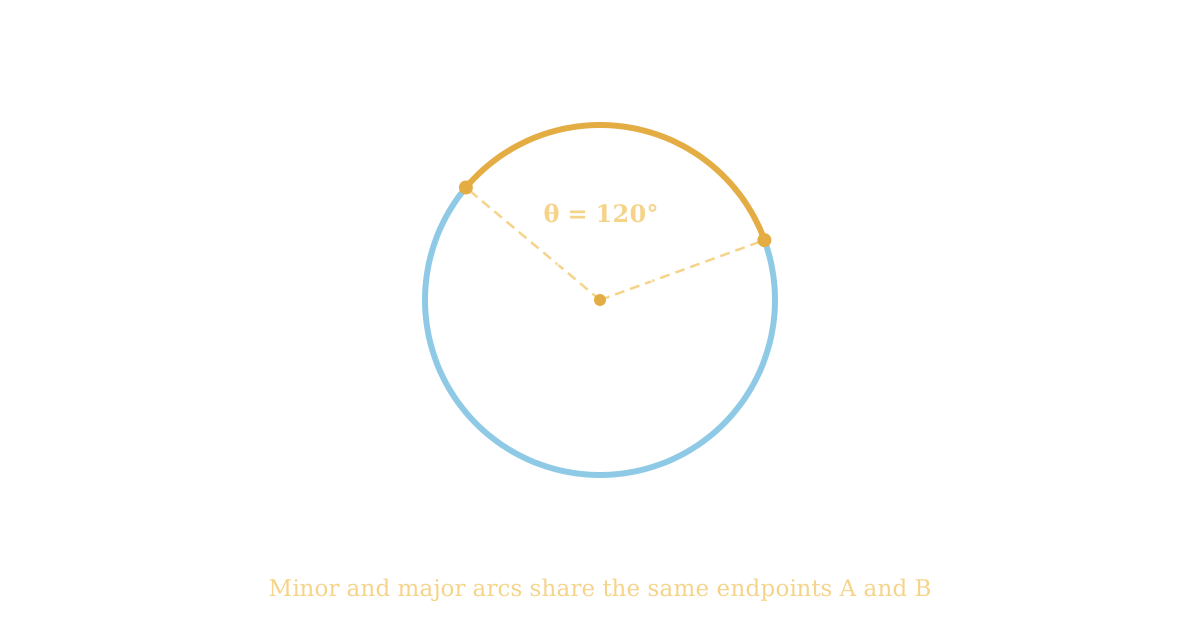
The central angle decides which is which. A central angle below 180° gives a minor arc. A central angle above 180° gives a major arc. Exactly 180° gives a semicircle, which is neither minor nor major: both arcs are equal.
| Central angle | Arc type | Arc length |
|---|---|---|
| 0° | Zero-length arc | L = 0 |
| Between 0° and 180° | Minor arc | L = rθ |
| 180° | Semicircle | L = πr |
| Between 180° and 360° | Major arc | L = rθ |
| 360° | Complete circle | L = 2πr |
Minor and major are complements. For a smaller central angle θ, the minor arc is Lminor = rθ and the major arc is Lmajor = r(2π - θ). Their sum is always the complete circumference:
Worked example. Radius 5 units, smaller angle 60°. The minor arc is L = 5 × π / 3 = 5.2359877560 units. The major arc uses the reflex angle 360° - 60° = 300°, so L = 5 × 5.2359877560 = 26.1799387799 units. The sum is 5.2359877560 + 26.1799387799 = 31.4159265359 units, which is exactly the circumference 2π × 5. The minor arc is 16.67% of the circle and the major arc is 83.33%.
Another example. Radius 4 units, angle 270°. This is already the major arc: L = 4 × 3π / 2 = 18.8495559215 units. Its complementary minor arc uses 90°: L = 4 × π / 2 = 6.2831853072 units. The sum is 25.1327412287 units, the full circumference 2π × 4.
Do not confuse the two angles. The most common minor/major error is using the smaller angle when the problem asks for the major arc, or the other way round. Always check whether the angle you were given is the smaller one or the reflex one, and remember that the calculator shows both arcs side by side so you can pick the one your problem needs.
Difference Between Arc Length and Chord Length
Arc length and chord length both connect the same two points on a circle, but they take different paths. The arc follows the curve. The chord cuts straight across. The arc is almost always longer.
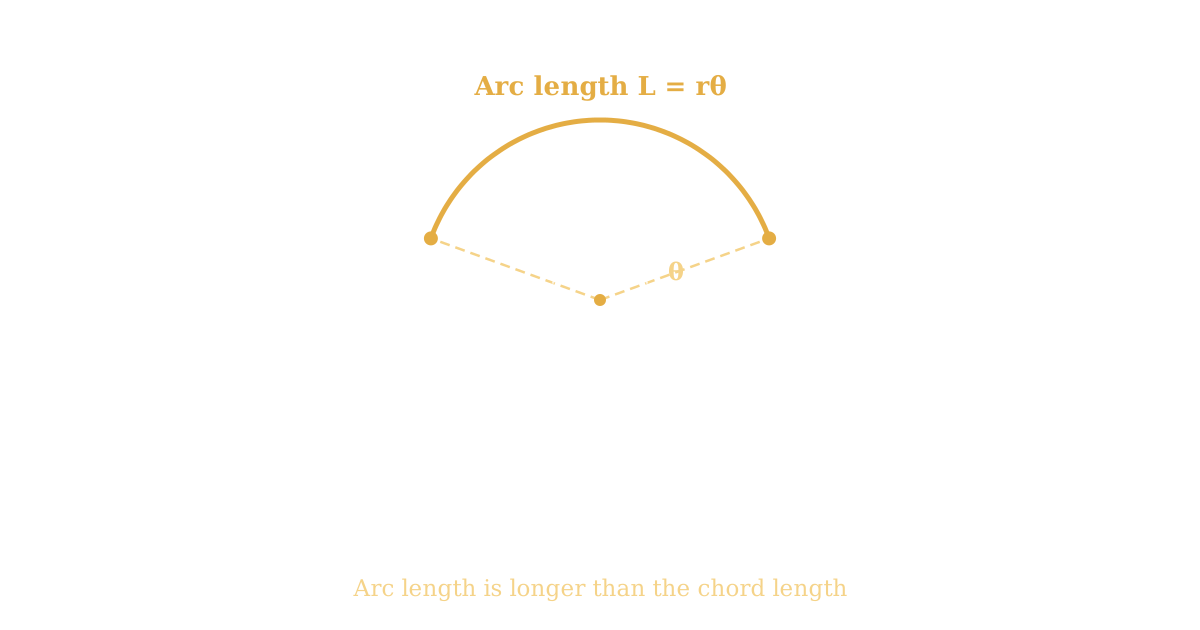
The formulas show the difference clearly:
The chord depends on the sine of half the angle, which grows more slowly than the angle itself, so the gap between arc and chord widens as the angle grows.
| Angle | Arc length (r = 5) | Chord length (r = 5) | Arc / chord |
|---|---|---|---|
| 30° | 2.6179938780 | 2.5881904510 | 1.0115151599 |
| 60° | 5.2359877560 | 5.0000000000 | 1.0471975512 |
| 90° | 7.8539816340 | 7.0710678119 | 1.1107207345 |
| 120° | 10.4719755120 | 8.6602540378 | 1.2091995762 |
| 180° | 15.7079632679 | 10.0000000000 | 1.5707963268 |
| 270° | 23.5619449019 | 7.0710678119 | 3.3321622036 |
Three facts from the table are worth remembering. At 30°, the arc is only about 1.15% longer than the chord, so for small angles the two are close. At 180°, the chord is the diameter, 10 units, while the arc is πr = 15.7079632679 units. At 270°, the chord shrinks back to 7.0710678119 units, the same as at 90°, because the chord depends on the smaller angle between the endpoints, while the arc keeps growing with the sweep.
Special case. At 60°, the chord equals the radius exactly: c = 2r sin(30°) = 2r × 0.5 = r. For r = 5, the chord is 5 units, and the radius, chord, and the two radii form an equilateral triangle. This is a handy check and a favourite of exam setters.
Why it matters. If you are cutting a curved pipe, you need the arc length. If you are measuring the straight gap between two points on a circular part, you need the chord. Mixing them up is one of the most common circle errors, and the calculator shows both values together so the difference is always visible.
Difference Between Arc Length and Sector Area
Arc length and sector area sound similar, but they measure different things. Arc length is a one-dimensional curved distance, measured in plain units. Sector area is a two-dimensional region, the wedge of the circle cut out by two radii and the arc, measured in square units.
The formulas look alike, which is exactly why they get confused:
The sector area is the arc length multiplied by half the radius: A = ½ × r × L. That relationship is a useful check. For a radius of 5 units and 60°, the arc is 5.2359877560 units, and the sector area is ½ × 5 × 5.2359877560 = 13.0899693900 square units.
| Radius and angle | Arc length | Sector area |
|---|---|---|
| r = 5, 60° | 5.2359877560 units | 13.0899693900 square units |
| r = 8, 90° | 12.5663706144 units | 50.2654824574 square units |
| r = 4, 270° | 18.8495559215 units | 37.6991118431 square units |
| r = 7, 120° | 14.6607657168 units | 51.3126800086 square units |
| r = 10, 180° | 31.4159265359 units | 157.0796326795 square units |
Units are the giveaway. If your answer should be a length, the unit is cm, m, or inches. If it should be an area, the unit is cm², m², or square inches. An arc-length answer in square units, or a sector-area answer in plain units, is certainly wrong. The calculator keeps the two separate and labels the units clearly.
A full-circle check. At 360°, the sector is the whole circle, so the sector area must equal πr². For r = 6, π × 36 = 113.0973355292 square units. The arc at the same time is the full circumference, 37.6991118431 units. Both come from the same radius and angle, but they answer different questions.
What Is a Circular Segment?
A circular segment is the region enclosed by an arc and its chord. Picture a slice of the circle cut off by a straight line: the curved edge is the arc, the straight edge is the chord, and the area between them is the segment. It is smaller than the sector, because the sector also includes the triangle formed by the two radii and the chord.
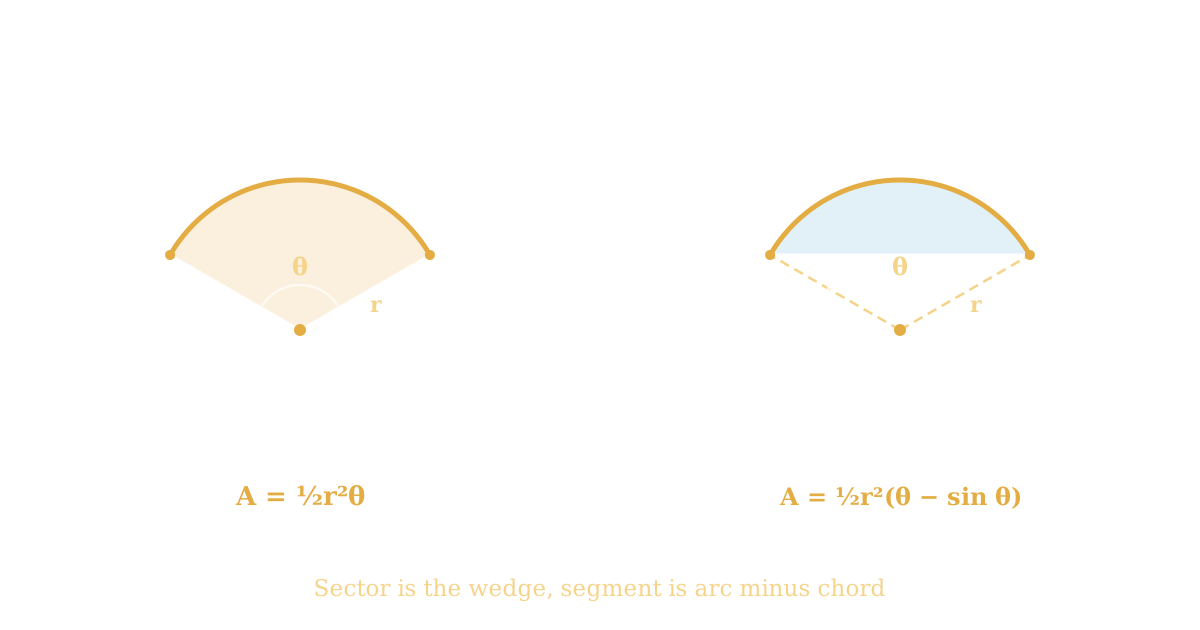
The segment area is the sector area minus the triangular area between the two radii and the chord:
Here θ is the central sweep in radians, between 0 and 2π. The formula handles both minor and major segments correctly: for a minor arc it gives the small cap, and for a major arc it gives the large region that covers most of the circle.
Worked examples. For r = 5 units and 60°, the sector area is 13.0899693900 square units and the segment area is ½ × 25 × (1.0471975512 - 0.8660254038) = 2.2646518427 square units. The segment is much smaller than the sector, because the triangle takes up most of the wedge. For r = 5 and 90°, the segment is 7.1349540849 square units. For r = 8 and 90°, the segment is 18.2654824574 square units.
Special cases. At 180°, sin θ = 0, so the segment area equals the sector area: ½ πr². For r = 5, both are 39.2699081699 square units, which is exactly half the circle. At 270°, sin θ = -1, so the segment is larger than the sector: for r = 5, the sector is 58.9048622548 square units and the segment is 71.4048622548 square units. At 360°, the chord vanishes and the segment is the whole circle, πr².
Segment vs sector, in one line. The sector is the wedge from the centre. The segment is the cap beyond the chord. If your problem involves the centre, you want the sector. If it involves only the arc and its chord, you want the segment.
Relationship Between Degrees and Radians
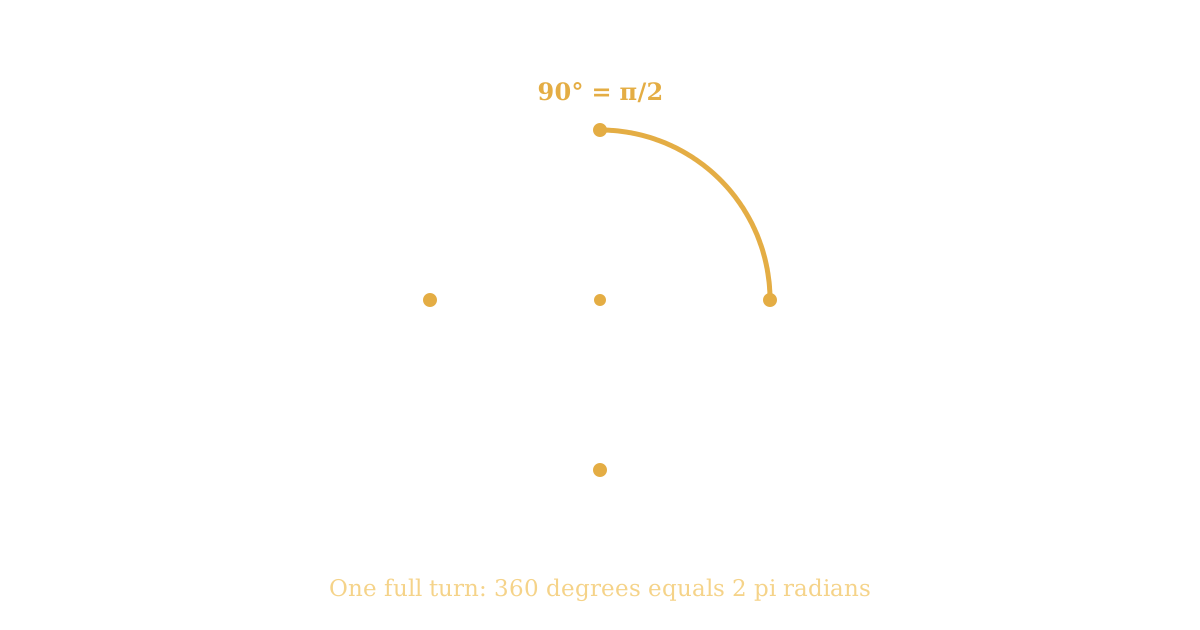
Degrees and radians are two units for the same thing, angle. Degrees split a full turn into 360 equal parts. Radians measure an angle by the arc it cuts off, in units of the radius. The two are linked by a single conversion: π radians equals 180°.
| Degrees | Radians | Fraction of a circle |
|---|---|---|
| 30° | π / 6 = 0.5235987756 | 1 / 12 |
| 45° | π / 4 = 0.7853981634 | 1 / 8 |
| 60° | π / 3 = 1.0471975512 | 1 / 6 |
| 90° | π / 2 = 1.5707963268 | 1 / 4 |
| 120° | 2π / 3 = 2.0943951024 | 1 / 3 |
| 180° | π = 3.1415926536 | 1 / 2 |
| 270° | 3π / 2 = 4.7123889804 | 3 / 4 |
| 360° | 2π = 6.2831853072 | 1 |
The conversion formulas are:
Worked conversions. 120° in radians is 120 × π / 180 = 2.0943951024 radians. 45° is 45 × π / 180 = 0.7853981634 radians. Going the other way, 1 radian is 1 × 180 / π = 57.2957795131°, and 2 radians is 114.5915590262°. That last value is useful: an arc becomes longer than the diameter exactly when the angle passes 2 radians.
Which unit should you use? Use degrees when the problem gives degrees, and radians when it gives radians. The calculator accepts both, and the DEG/RAD toggle converts your angle without changing the arc. For hand calculation, degrees suit the fraction form L = πrθ / 180, while radians suit the clean form L = rθ. Either way, never mix the two in one formula.
Calculating from Circumference, Chord, or Area
Sometimes neither the radius nor the diameter is given. The calculator works backwards from four other measurements by deriving the radius first, then applying L = rθ as usual. All six methods give the same radius and the same arc length for the same circle, so you can use whichever measurement you actually have.
From full circle circumference. The full circumference is C = 2πr, so r = C / (2π). For C = 31.4159265359 units, r = 31.4159265359 / 6.2831853072 = 5 units. Then a 60° arc is L = 5 × π / 3 = 5.2359877560 units. Notice the shortcut: a 60° arc is one sixth of the circumference, and 31.4159265359 / 6 = 5.2359877560 units.
From chord length. The chord formula is c = 2r sin(θ / 2), so r = c / [2 sin(θ / 2)]. For a chord of 5 units with a 60° angle, r = 5 / (2 × sin 30°) = 5 / (2 × 0.5) = 5 units. Then L = 5.2359877560 units. Chord input only works when the angle is strictly between 0° and 360°: at 0° or 360° the chord is zero and no radius can be recovered, so the calculator rejects those angles for this method.
From full circle area. The area of a full circle is A = πr², so r = √(A / π). For A = 78.5398163397 square units, r = √(78.5398163397 / π) = √(25) = 5 units. Then a 60° arc is L = 5.2359877560 units. You can verify the radius by putting it back into the area formula: π × 25 = 78.5398163397 square units.
From sector area. The sector area is A = ½r²θ, so r = √(2A / θ) with θ in radians. For a sector area of 13.0899693900 square units with a 60° angle, θ = 1.0471975512 radians, so r = √(2 × 13.0899693900 / 1.0471975512) = √(25) = 5 units. Then L = 5.2359877560 units. This method needs the angle as well as the area, because the same sector area can come from many radius and angle combinations.
Which input to use. Use whichever measurement you actually have. If two different measurements give different radii, one of the measurements is wrong, and that disagreement is worth investigating before trusting either answer.
Practical Applications of Circle Arc Length
Arc length is not an abstract classroom exercise. Anywhere a curved distance on a circle has to be measured, cut, built, or travelled, the same formula applies.
Engineering and manufacturing. Pipe bending starts with arc length: a pipe bent through 90° with a bend radius of 8 units needs 12.5663706144 units of pipe for the bend alone. Sheet metal rolled into a curved panel, a gear tooth profile, and a cam shape all need the curved length before the material is cut. Getting it wrong wastes material or leaves a part short.
Architecture and construction. Arched doorways, circular windows, domes, and curved staircases are dimensioned by their arcs. A semicircular arch with a radius of 10 units needs 31.4159265359 units of trim along the curve. A circular garden bed edging order needs the arc for the curved side and the diameter for the straight side, which are different numbers.
Roads and tracks. A circular road curve, a running track bend, or a railway curve is laid out by radius and central angle. The length of the curve decides the amount of asphalt, the length of rail, and the distance a vehicle travels through the bend. A 120° curve with a radius of 7 units is 14.6607657168 units long.
Clocks, wheels, and robotics. A clock hand sweeps an arc as time passes. A wheel rolling along the ground covers a distance equal to the arc it turns through. A robot arm rotating about a joint moves its gripper along a circular arc, and the distance it travels is rθ, which is why radians are the natural unit in robotics.
Computer graphics and CAD. Curves in CAD models, fonts, and animations are built from circular arcs. The length of an arc decides how a tool path is divided, how a curve is rendered, and how far an object moves along a circular path in an animation.
A note on real shapes. Not every curved structure is a perfect circle. Real arches can be elliptical or parabolic, and real roads use clothoid transitions. The circle formulas on this page apply exactly when the curve is a true circular arc, and they are a good approximation only when the curve is close to circular. Always confirm the shape before applying the formula.
Common Mistakes When Calculating Arc Length
Most wrong answers in circle arc length come from a small list of errors. Checking for each one takes seconds and saves most mistakes.
- Using diameter instead of radius. The formula needs r, not d. Using d = 14 as the radius doubles the answer: 29.3215314336 instead of 14.6607657168 for a 120° arc. Halve the diameter first.
- Forgetting to convert degrees into radians. L = rθ needs radians. Putting 60° straight in gives 5 × 60 = 300 instead of 5.2359877560. Convert first, or use L = πrθ / 180.
- Confusing the central angle with an inscribed angle. An inscribed angle is half the central angle that subtends the same arc. If a problem gives an inscribed angle φ, the central angle is θ = 2φ, and the arc is L = r × 2φ. Using φ directly halves the answer.
- Mixing major and minor arcs. An angle of 270° gives a major arc of 18.8495559215 units for r = 4. Using the smaller angle 90° instead gives 6.2831853072 units, the minor arc. Check which arc the problem asks for.
- Confusing arc length with chord length. The chord is the straight line, always shorter than the arc. For r = 5 and 180°, the chord is 10 units and the arc is 15.7079632679 units. They are equal only in the zero-length limiting case.
- Confusing sector area with arc length. Sector area is a two-dimensional region in square units. Arc length is a one-dimensional distance in plain units. For r = 5 and 60°, the sector area is 13.0899693900 square units and the arc is 5.2359877560 units. Different quantities, different units.
- Using the wrong measurement units. A radius in cm and an angle in degrees is fine, but the answer comes out in cm. Mixing cm and inches in one calculation, or forgetting to convert the output unit, gives a number with the wrong size. Convert first, calculate second.
- Rounding π too early. Replacing π with 3.14 before multiplying introduces an error that grows with the radius. Keep full-precision π through the calculation and round only the final displayed result.
- Forgetting that a full circle represents 360°. An angle of 360° is the complete circumference, 2πr, not zero. An angle of 0° is the zero-length arc. The two look similar on a diagram, because the endpoints coincide, but their arc lengths are as different as possible.
- Using the wrong angle interval. Arc length formulas for a circle assume the sweep is between 0° and 360°. An angle of 450° is not a valid single sweep on one circle: it is a full turn plus 90°, and the arc for one circle is the 90° remainder, 12.5663706144 units for r = 8.
A final check that catches most of these. Verify the result against the circumference. The arc must be between 0 and 2πr, it must be longer than the chord, and the minor plus major arcs must add to exactly 2πr. If any of those checks fails, one of the ten mistakes above is the cause.
Worked Examples
These six examples cover the calculator's main input methods and arc types. Each one is calculated by the same engine that powers the tool, and each result has been verified independently.
Example 1: Minor arc with radius 5 and 60°. Given r = 5 units, θ = 60° = π / 3 radians. Arc length L = 5 × π / 3 = 5.2359877560 units. Diameter d = 10 units. Chord c = 2 × 5 × sin(30°) = 5 units. Sector area A = ½ × 25 × π / 3 = 13.0899693900 square units. Complete circumference C = 31.4159265359 units.
Example 2: Quarter circle arc with radius 8 and 90°. Given r = 8 units, θ = 90° = π / 2 radians. Arc length L = 8 × π / 2 = 12.5663706144 units. Chord c = 2 × 8 × sin(45°) = 11.3137084990 units. Sector area A = ½ × 64 × π / 2 = 50.2654824574 square units. The arc is exactly one quarter of the circumference 50.2654824574 units.
Example 3: Major arc with radius 4 and 270°. Given r = 4 units, θ = 270° = 3π / 2 radians. Arc length L = 4 × 3π / 2 = 18.8495559215 units. Chord c = 2 × 4 × sin(135°) = 5.6568542495 units. Sector area A = ½ × 16 × 3π / 2 = 37.6991118431 square units. Complementary minor arc, using 90°, is 6.2831853072 units. The two arcs add to 25.1327412287 units, the full circumference.
Example 4: Arc from diameter 14 and 120°. Given d = 14 units, θ = 120° = 2π / 3 radians. Radius r = 14 / 2 = 7 units. Arc length L = 7 × 2π / 3 = 14.6607657168 units. Chord c = 2 × 7 × sin(60°) = 12.1243556530 units. Sector area A = ½ × 49 × 2π / 3 = 51.3126800086 square units. Segment area is 30.0950576159 square units.
Example 5: Semicircle with radius 10 and 180°. Given r = 10 units, θ = 180° = π radians. Arc length L = 10 × π = 31.4159265359 units. Chord c = 2 × 10 × sin(90°) = 20 units, the diameter. Sector area A = ½ × 100 × π = 157.0796326795 square units, exactly half the full circle area. The arc is π / 2 times the diameter, about 57.08% longer than the straight line across.
Example 6: Full circle with radius 6 and 360°. Given r = 6 units, θ = 360° = 2π radians. Arc length L = 6 × 2π = 37.6991118431 units, which is the complete circumference. Chord c = 0, because the endpoints coincide. Sector area A = ½ × 36 × 2π = 113.0973355292 square units, the full circle area. Arc percentage is 100%.
Click any preset button in the calculator to load one of these examples and see the full step-by-step solution, the live diagram, and all the secondary results for that input.
Circle Arc Length FAQs
What is the formula for circle arc length? +
The formula is L = rθ, where L is the arc length, r is the radius, and θ is the central angle in radians. In degrees, the same formula is L = πrθ / 180. For a radius of 5 units and 60°, L = 5 × π / 3 = 5.2359877560 units.
How do you calculate arc length using radius? +
Multiply the radius by the central angle in radians: L = rθ. For a radius of 8 units and 90°, first convert 90° to π / 2 radians, then L = 8 × π / 2 = 12.5663706144 units. The calculator on this page does the same steps and shows each one.
How do you calculate arc length using diameter? +
Halve the diameter to get the radius, then use L = rθ. Equivalently, use L = πdθ / 360 directly with θ in degrees. For a diameter of 14 units and 120°, the radius is 7 units and L = 7 × 2π / 3 = 14.6607657168 units. The most common error is forgetting the division by two, which doubles the answer.
How do you calculate arc length in degrees? +
Use L = πrθ / 180 with θ in degrees. For a radius of 5 units and 120°, L = π × 5 × 120 / 180 = 10.4719755120 units. The formula works because θ / 360 is the fraction of the full circle the arc covers, and 2πr is the full circumference.
How do you calculate arc length in radians? +
Use L = rθ with θ in radians. For a radius of 4 units and θ = π / 2 radians, L = 4 × 1.5707963268 = 6.2831853072 units. Radians make the formula clean because a radian is defined by the radius itself, so no π appears in the formula.
What is the difference between a minor arc and major arc? +
The minor arc is the shorter of the two arcs between two points on a circle, and the major arc is the longer one. A central angle below 180° gives a minor arc, above 180° gives a major arc, and exactly 180° gives a semicircle, where both are equal. For a radius of 5 units and 60°, the minor arc is 5.2359877560 units and the major arc is 26.1799387799 units.
How do you calculate the length of a major arc? +
Use the reflex angle, 360° minus the smaller angle, in the same formula: Lmajor = r(2π - θ), with θ the smaller angle in radians. For a radius of 4 units with a smaller angle of 90°, the major arc uses 270°: L = 4 × 3π / 2 = 18.8495559215 units. The minor and major arcs always add to the full circumference, 2πr.
Is arc length the same as circumference? +
No, except for a complete circle. Circumference is the arc length of the whole circle, C = 2πr, which corresponds to a 360° angle. Any smaller angle gives a shorter arc: a 90° arc is one quarter of the circumference, a 180° arc is one half. For a radius of 6 units, the circumference is 37.6991118431 units, but a 60° arc on the same circle is only 6.2831853072 units.
What is the difference between arc length and chord length? +
Arc length is measured along the curve, L = rθ, while chord length is the straight-line distance between the two endpoints, c = 2r sin(θ / 2). The arc is almost always longer: for a radius of 5 units and 90°, the arc is 7.8539816340 units and the chord is 7.0710678119 units. The two are equal only for a zero-length arc.
How many radians are in a full circle? +
A full circle contains 2π radians, about 6.2831853072 radians. A half circle contains π radians, and a quarter circle contains π / 2 radians. The conversion is radians = degrees × π / 180, so 360° becomes 360 × π / 180 = 2π radians.
How do you calculate a semicircle's arc length? +
A semicircle has a central angle of 180°, or π radians, so L = πr. For a radius of 10 units, L = π × 10 = 31.4159265359 units. If you know the diameter instead, use L = πd / 2: a diameter of 20 units gives the same 31.4159265359 units.
Can arc length be greater than the diameter? +
Yes, when the central angle is large enough. Arc length exceeds the diameter exactly when the angle is greater than 2 radians, about 114.59°. For a radius of 5 units, the diameter is 10 units: a 90° arc is 7.8539816340 units, shorter than the diameter, while a 180° arc is 15.7079632679 units, longer. At 360° the arc is the full circumference, 31.4159265359 units.
What is the relationship between arc length and sector area? +
They are linked by the radius: sector area A = ½ × r × L, where L is the arc length. For a radius of 5 units and 60°, the arc is 5.2359877560 units and the sector area is ½ × 5 × 5.2359877560 = 13.0899693900 square units. Arc length is a one-dimensional distance in plain units, while sector area is a two-dimensional region in square units.
Can I calculate arc length using chord length? +
Yes. Recover the radius first with r = c / [2 sin(θ / 2)], then use L = rθ. For a chord of 5 units with a 60° angle, r = 5 / (2 × sin 30°) = 5 / 1 = 5 units, and L = 5 × π / 3 = 5.2359877560 units. The method needs an angle strictly between 0° and 360°, because a zero chord carries no information about the radius.
What is the difference between a circular sector and segment? +
A sector is the wedge formed by two radii and the arc, with area A = ½r²θ. A segment is the region between the arc and its chord, with area A = ½r²(θ - sin θ). The segment is the sector minus the triangle formed by the two radii and the chord. For a radius of 5 units and 60°, the sector is 13.0899693900 square units and the segment is 2.2646518427 square units.