How to Find Arc Length Without Calculus: Simple Methods and Examples
Learn how to find arc length without calculus. Use simple circle formulas in degrees and radians, and approximate any curve with straight segments.
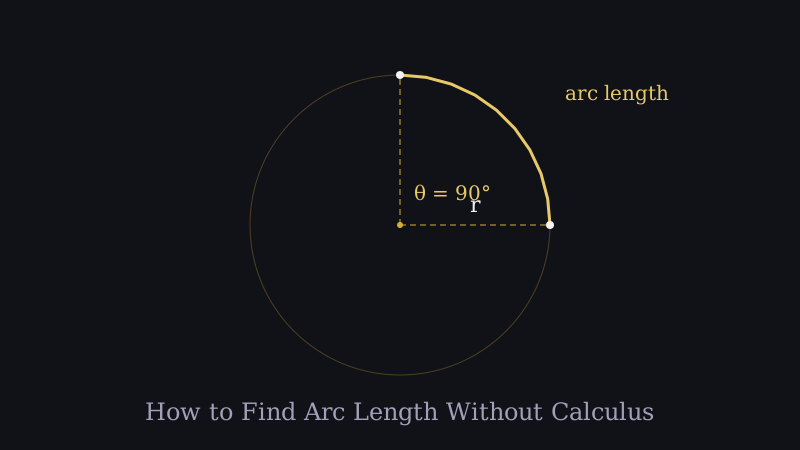
How to Find Arc Length Without Calculus: Simple Methods and Examples
You can measure most curves without a single derivative.
Picture a slice of pizza. The crust forms a curve, and if you wanted to know how long that crust is, you would not need calculus. A ruler cannot follow a bend, but a little geometry can. This guide shows you how to find arc length without calculus in two common cases: the exact length of a circular arc, and a close estimate for any other curve. You only need basic arithmetic, the idea of a fraction of a circle, and the Pythagorean theorem. Check your answers any time with our Arc Length Calculator.
What Is Arc Length?
Arc length is the distance along a curve, measured the long way round.
An arc is a piece of a curve between two points. Its arc length is the distance you travel if you walk along the curve from one point to the other, instead of cutting straight across. The two points also define a chord, the straight line that joins them. The chord is always shorter than the arc, because a straight line is the shortest path between two points.
Two things fix the length of a circular arc: the radius of the circle and the central angle, the angle at the centre between the two radii that reach the ends of the arc. A bigger radius or a bigger angle both make a longer arc. A familiar example is a running track: the bends are arcs, and the two straight sections join them. The crust of a pizza slice is another arc, and its length depends on the size of the slice and the size of the whole pizza. The two radii and the arc also enclose a sector, the pizza-slice shape itself, which our Sector Arc Length Calculator covers in full.
Can You Find Arc Length Without Calculus?
Yes, for circles the answer is exact, and for other curves it is a close estimate.
A circle is perfectly regular, so any arc is a simple fraction of the whole circumference. That fraction comes straight from the central angle, and no calculus is involved. For a general curve, such as the path of a thrown ball or a wavy line on a graph, there is no single formula from basic geometry. Instead, you break the curve into short straight pieces, measure each piece with the Pythagorean theorem, and add the pieces up. This is called polygonal approximation. More pieces give a better estimate, but the result stays an estimate, not an exact value. Knowing which case you are in is the whole skill: exact for circles, estimated for everything else.
Method 1: Find Arc Length Using the Circle Formula
Take a fraction of the full circumference.
The circumference of a circle is . An arc that spans an angle is the fraction of the whole circle, so its length is:
Here is the arc length, is the central angle in degrees, is the radius, and is about . You divide by because a full circle turns through degrees, so is the share of the circle your arc covers.
Worked example: Find the arc length of a circle with radius cm and a central angle of .
- Write down the values: cm, .
- Put them into the formula: .
- Simplify the fraction: .
- Work out the circumference: .
- Multiply: .
- As a decimal: cm.
A quick check helps: is one sixth of a circle, and the full circumference is about cm, so one sixth is about cm. The answer makes sense. A semicircle is the simplest case of all: its angle is , so its arc is half the circumference, , as shown by our Semicircle Arc Length Calculator. If you want to skip the hand calculation, try our Circle Arc Length Calculator.
Method 2: Find Arc Length Using Radians
Radians make the formula shorter, because one radian is built from the radius.
A radian is the angle you get when the arc length equals the radius. Since the circumference is , a full circle is radians, and a half circle is radians. To change degrees into radians, multiply by ; is the same angle as radians. With the angle in radians, the formula is:
Here is the arc length, is the radius, and is the central angle in radians. There is no and no in the formula itself, because the radian already carries that information.
Worked example: Find the arc length when the radius is cm and the angle is radians.
- Write down the values: cm, radians.
- Put them into the formula: .
- As a decimal: cm.
Use degrees when a problem gives you degrees, as in most school geometry. Use radians when a problem gives you radians, or when you are working in trigonometry or physics. Both formulas give the same answer for the same arc. You can see that for yourself in the comparison below.
Degree Formula
Radian Formula
Method 3: Approximate the Length of a Curved Line
Break the curve into short straight pieces, then add them up.
A general curve has no single arc length formula in basic geometry, but straight lines do. Pick points along the curve, join neighbouring points with straight segments, find each segment with the distance formula, and add the results. The distance formula comes from the Pythagorean theorem:
Follow these five steps:
- Select points along the curve, in order from one end to the other.
- Connect neighbouring points with straight lines.
- Calculate each segment’s length with the distance formula.
- Add the segment lengths together.
- Improve the approximation by taking more points, which shortens each segment.
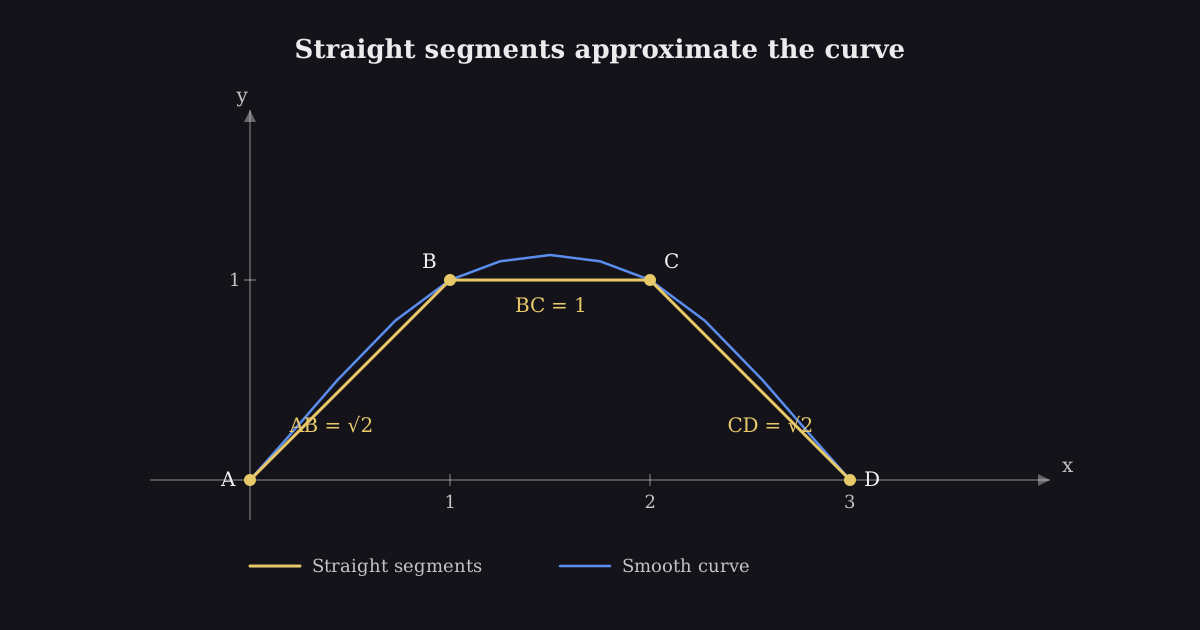
Worked example: Approximate the curve through the points , , , and .
Total polygonal length units.
This total is an approximation of the underlying curve’s length, not automatically its exact length. The straight segments cut across the bends, so the estimate is usually a little short, and it gets closer to the true length as you add more points. For longer point lists, our Arc Length from Points tool does the adding for you.
How to Find Arc Length When the Central Angle Is Unknown
Measure the chord, then work the angle back from it.
Sometimes you know the radius and the chord length, but not the angle. The chord, the two radii, and the central angle form an isosceles triangle, and the chord length follows:
Rearrange it to find the angle:
Then use with in radians. Note that gives the smaller angle, so this finds the minor arc, the shorter way round. The major arc, the longer way round, is the rest of the circle: minus the minor angle, or minus the minor angle in radians.
Quick check: A circle has radius cm and a chord of cm. Then , and , so , which is radians. The arc length is cm.
Common Mistakes When Calculating Arc Length
Most wrong answers come from six small slips.
- Using diameter instead of radius. The formulas use the radius . If a problem gives a diameter of , halve it to first, or your answer doubles.
- Mixing degrees and radians. An angle of is not radians. Check the unit before you pick a formula, and check your calculator mode too.
- Confusing chord length with arc length. The chord cuts straight across, so it is always shorter than the arc between the same two points.
- Forgetting units. Arc length is a length, so it needs cm, m, or inches, just like the radius. An angle has no length units.
- Treating an approximation as an exact answer. A polygonal total is an estimate. Say so, and say how many points you used.
- Applying circular arc formulas to arbitrary curves. only works for circles. A wavy line needs the segment method from Method 3.
Frequently Asked Questions About Arc Length
Short answers to the questions students ask most.
1. Can you calculate arc length without calculus? Yes. Circular arcs use the geometry formulas in Method 1 and Method 2, and general curves can be estimated with straight segments as in Method 3.
2. What is the easiest formula for finding arc length? For a circle with the angle in radians, is the easiest: multiply the radius by the angle. In degrees, use .
3. How do you find arc length without knowing the central angle? Measure the chord and the radius , find , then use with the angle in radians.
4. Is arc length the same as chord length? No. Arc length follows the curve, while chord length is the straight line between the same two points, so the arc is always longer.
5. Can you find the length of an irregular curve without calculus? You can estimate it. Join points along the curve with straight segments, add the segment lengths, and use more points for a better estimate. An exact value needs calculus.
6. How does the Pythagorean theorem help find arc length? It gives the distance formula, which measures each straight segment in a polygonal approximation. Add the segments to estimate the curve.
7. Does adding more points make an arc-length approximation more accurate? Yes. Shorter segments follow the bends more closely, so the total moves closer to the true length of the curve.
Further Reading
If you want to go deeper, these pages explain the same ideas from other angles.
- Maths is Fun: Circle Sector and Segment: arc length in degrees and radians, with interactive diagrams.
- Wikipedia: Arc length: polygonal approximation and the circle formulas.
- Wolfram MathWorld: Arc Length: the formal definition and the circle case.