10 Common Arc Length Mistakes and How to Avoid Them
The 10 most common arc length mistakes, each with the wrong calculation, the corrected one, and a habit that stops it.
10 Common Arc Length Mistakes and How to Avoid Them
Ever used the right formula and still got the wrong answer?
One slip with the angle, the radius, or the units can spoil a correct method. This guide covers the ten mistakes students make most often, with the wrong calculation, the corrected one, and a habit that stops each error. Check your answers with our Arc Length Calculator, and read Arc Length of a Circle for the full formulas.
Understanding the Arc Length Formula
Two formulas, one choice: match the formula to the angle unit.
Using degrees:
Using radians:
Here is the arc length, is the radius, and is the central angle. Use the degree formula when the angle is in degrees, and only when the angle is in radians. Read Degrees vs. Radians in Arc Length if the two units still feel shaky.
10 Common Arc Length Mistakes and How to Avoid Them
Ten slips, each with the wrong working, the fix, and a habit that prevents it.
Mistake 1: Using Degrees Instead of Radians in the Formula
The short formula only works with radians.
Why it happens: The formula looks like plain multiplication, so students plug the degree number straight in. But a radian is defined by arc length over radius.
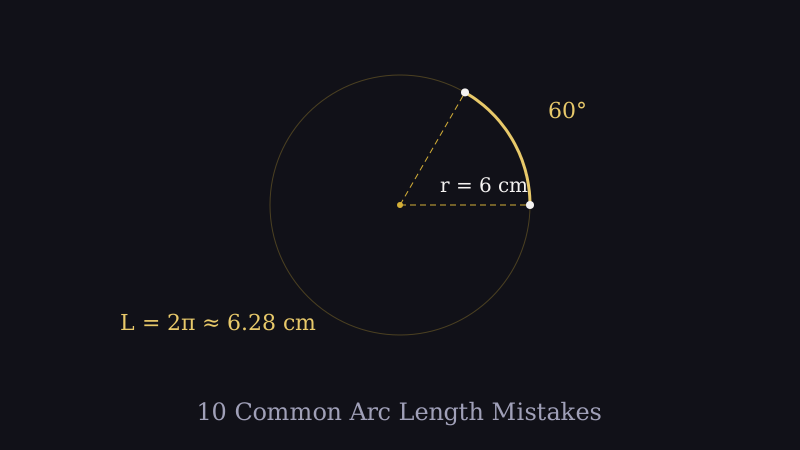
Incorrect: Radius 6 cm, angle : cm.
Correct: Convert first: radians. Then cm.
Tip: Check the unit first. A degree sign means convert, or switch to the degree formula.
Mistake 2: Using Radians in the Degree-Based Formula
The degree formula needs degrees, not radians.
Why it happens: Students reach for the longer formula with a radian angle still in place. The part only makes sense when counts degrees out of 360.
Incorrect: Radius 4 cm, angle radians: cm.
Correct: Convert first: radians . Then cm.
Tip: Match the formula to the angle unit. Convert the angle, never force it into the wrong formula.
Mistake 3: Confusing Radius with Diameter
The formulas use the radius, which is half the diameter.
Why it happens: Questions often give the diameter, and the full width is the number students remember. Using it as doubles every answer.
Incorrect: Diameter 10 cm, angle , using 10 as the radius: cm.
Correct: Halve the diameter first: cm. Then cm.
Tip: Write at the top of your working. If the question gives a diameter, halve it first.
Mistake 4: Forgetting to Divide the Angle by 360
The degree formula takes a fraction of the full circumference.
Why it happens: Students remember and forget the arc is only part of the circle, so the answer comes out as the whole circumference.
Incorrect: Radius 4 cm, angle : cm.
Correct: cm. A angle is a quarter of the circle, so the arc is a quarter of the circumference.
Tip: Ask what fraction of the circle your angle is. is a quarter, is a half, is a sixth.
Mistake 5: Using the Wrong Central Angle
An inscribed angle is half the central angle for the same arc.
Why it happens: Diagrams often show an angle on the circumference, and students use it as if it sat at the centre, but the inscribed angle is only half the size.
Incorrect: An inscribed angle of stands on an arc in a circle of radius 8 cm. Using as the central angle: cm.
Correct: Double the inscribed angle: . Then cm.
Tip: Check where the angle sits. If its vertex is on the circumference, double it first.
Mistake 6: Confusing Arc Length with Arc Measure
Arc measure is an angle in degrees, arc length is a distance in cm.
Why it happens: Both describe the same arc, so 60 feels like the answer. But counts the turn, not the distance along the curve.
Incorrect: An arc measures in a circle of radius 6 cm, so its length is 60 cm.
Correct: The angle is , which is of the circle. cm.
Tip: A length always needs a length unit. No cm or m means you probably quoted the angle.
Mistake 7: Confusing Arc Length with Chord Length
The arc curves, the chord cuts straight across.
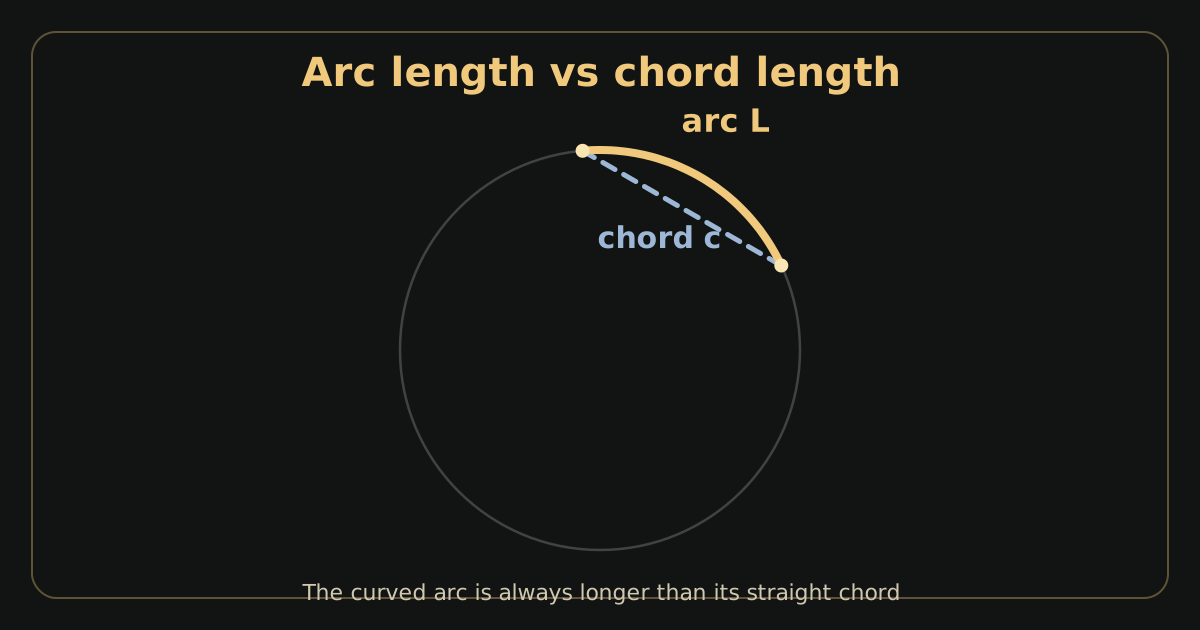
Why it happens: Both join the same two points, so students treat them as the same distance. But the chord is always shorter, because a straight line beats a curve.
Incorrect: Radius 5 cm, angle . The chord length cm is given as the arc length.
Correct: Arc length: cm. Chord length: cm.
Tip: Picture the two routes: the arc bends outward, the chord goes straight.
Mistake 8: Choosing the Wrong Arc (Major or Minor)
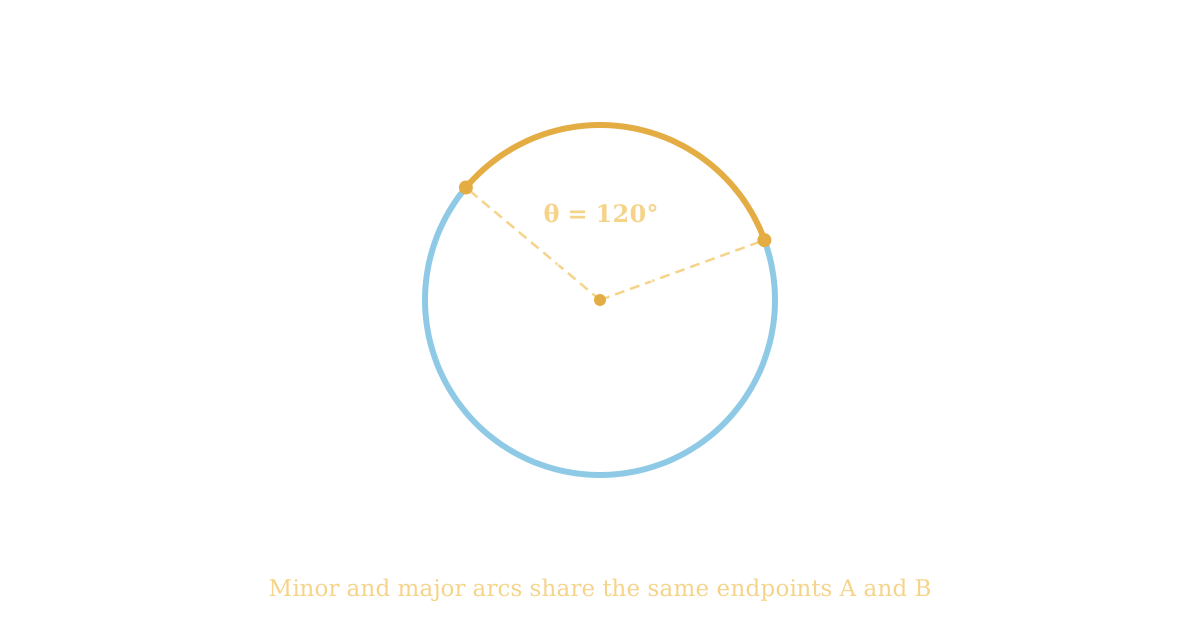
Two points split a circle into a short arc and a long one.
Why it happens: Questions name an arc without saying major or minor, or students use the first angle they see. The wrong choice gives a very different answer.
Incorrect: Radius 6 cm, major arc asked for, minor central angle . Using : cm.
Correct: Minor arc: cm. Major arc: the angle is , so cm.
Tip: Underline which arc the question asks for. A major arc is always more than half the circumference.
Select Arc Type:
Mistake 9: Confusing Arc Length with Sector Area or Perimeter
Length, area, and perimeter are three different measures.
Why it happens: The sector formulas share the same and , so students grab the area formula when the question asks for a length. The units give it away: area ends in cm².
Incorrect: Radius 4 cm, angle radians, using the area formula for the length: cm².
Correct: Arc length: cm. Sector area: cm². Sector perimeter: cm.
Tip: Check the unit the question asks for. A length comes from , never from an area formula.
Mistake 10: Making Unit, Calculator or Rounding Errors
Small slips in units and rounding spoil exact working.
Why it happens: Students mix cm and m, round to 3.14 mid-calculation, or use the wrong calculator mode for sine and cosine. Each slip is small, but the answer still comes out wrong.
Incorrect: Radius 50 cm, angle , treating 50 cm as 50 m: m.
Correct: Convert first: 50 cm m. Then m. Keep in the working and round only the final answer.
Tip: Convert all lengths to one unit before you start, and check DEG or RAD before any sine or cosine key. , but radians .
How to Check Whether Your Arc Length Answer Is Correct
Six quick checks before you hand in your work.
- Check the formula: degrees go with , radians with .
- Check the angle: is it a central angle, in the right unit, for the right arc?
- Check the radius: halve any diameter first.
- Compare with the circumference: a minor arc is shorter than half the circumference, a semicircle equals half of it, and a major arc is longer than half but shorter than the full circle.
- Check the units: the answer needs cm, m, or another length unit.
- Check the rounding: keep full precision until the last step, then round once.
Practice Problems: Identify and Correct Arc Length Mistakes
Five questions, then check your work below.
- A student writes cm for radius 3 cm and angle . Find the error and correct it.
- Diameter 12 cm, angle . A student uses 12 cm as the radius and gets cm. Find the error and correct it.
- Radius 7 cm, angle . A student writes cm. Find the error and correct it.
- Radius 6 cm, angle . A student gives the chord length, about 10.39 cm, as the arc length. Find the error and correct it.
- Radius 9 cm, minor angle , major arc asked for. A student answers cm. Find the error and correct it.
Answer key:
- Degrees went into . radians, so cm.
- The diameter was used as the radius. cm, so cm.
- The angle was never divided by 360. cm.
- The chord is not the arc. cm.
- The minor arc angle was used. The major angle is , so cm.
Frequently Asked Questions
Short answers.
1. What are the most common mistakes when calculating arc length? Using degrees in , mixing up radius and diameter, forgetting to divide by 360, and confusing arc length with chord length or sector area.
2. Can you use degrees directly in the arc-length formula? Only in the degree formula, . The short formula needs radians, so convert degrees first.
3. Should you use radius or diameter when finding arc length? Always the radius. If the question gives a diameter, halve it first: .
4. Why do you divide the central angle by 360? Because the degree formula takes a fraction of the full circumference. is of the circle, so the arc is a quarter of .
5. What is the difference between arc length and chord length? Arc length is the curved distance along the circle, while chord length is the straight line between the same two points. The arc is always longer.
6. Can arc length be greater than the circumference? No. The longest arc on a circle is the full circumference itself, . Any single arc is that length or shorter.
7. How can I check whether my arc-length answer is correct? Compare it with the circumference: a minor arc is less than half, a semicircle is half, and a major arc is more than half but less than the whole circle.
8. What is the easiest way to avoid arc-length calculation mistakes? Write down the angle unit, the radius, and the formula first, then run the six checks above.
Further Reading
More on the same ideas:
- Mathematics LibreTexts: Arclength and Radians: arc length, radian measure, and the formula .
- K12 LibreTexts: Length of an Arc: worked arc-length examples with radians.
- Wikipedia: Circular arc length: the formal definition and formulas.
- OpenStax Algebra and Trigonometry 2e: Angles: degree and radian measure, with worked examples.
- Maths is Fun: Radians: a plain-English introduction to radians.