Degrees vs. Radians in Arc Length: Formulas, Conversion, and Examples
Learn degrees vs radians in arc length: both conversion formulas, worked examples, a comparison table, and five practice problems with answers.
Degrees vs. Radians in Arc Length: Formulas, Conversion, and Examples
One angle, two units, and the wrong one can change your answer.
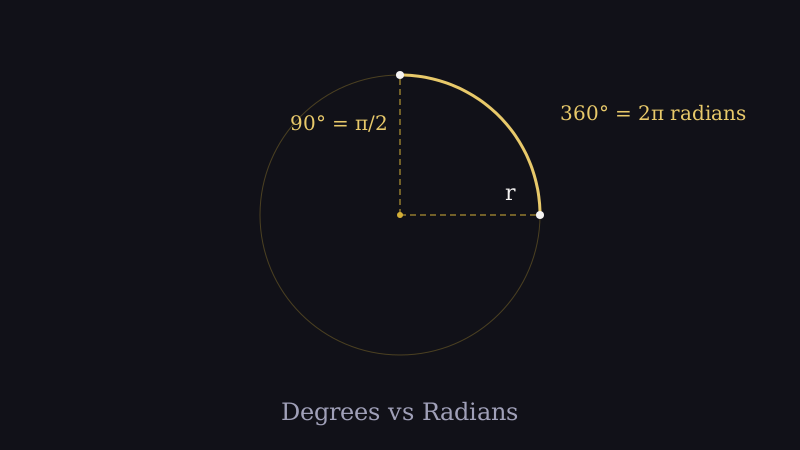
Why can the same angle be 90 degrees and π/2 radians? Both measure the turn of a central angle, but they count it differently: degrees split a full turn into 360 equal parts, while radians measure the turn in radius lengths. The unit decides which arc-length formula works, and mixing them up is one of the most common errors in geometry. This guide explains both systems, shows how to convert between them, and works one arc-length problem both ways. Check any result with our Arc Length Calculator, and read Arc Length of a Circle for the full circle formulas.
What Are Degrees and Radians?
Degrees split a circle into 360 parts; radians measure it in radius lengths.
Understanding Degrees
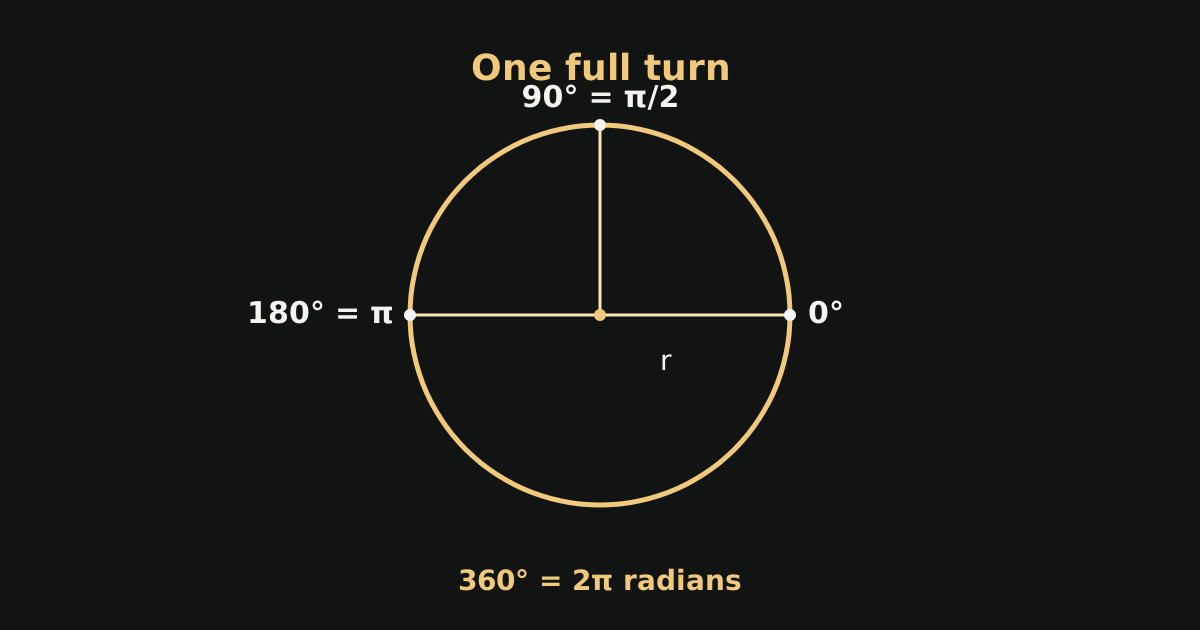
A complete circle contains 360 degrees, a half circle 180 degrees, and a quarter circle 90 degrees. A right angle is 90°, a straight line is 180°, and a full turn brings you back to 360°. Degrees suit everyday measurement, because 360 divides neatly into halves, quarters, thirds, and sixths.
Understanding Radians
A radian measures an angle by the arc it cuts off.
One radian is the central angle that subtends an arc equal in length to the radius. That definition links angle, arc length, and radius:
Here is the angle in radians, the arc length, and the radius. If the radius is 5 cm and the arc is 5 cm long, the angle is 1 radian. A full circumference is , so a full circle is radians and a half circle is radians. That gives the key link between the two systems:
What Is the Difference Between Degrees and Radians?
Same angle, different units, like inches and centimetres.
Degrees and radians describe the same turn, only the numbers differ. A quarter turn is or radians, a half turn is or radians, and a full turn is or radians. Neither unit is more correct; the right choice depends on the problem.
| Feature | Degrees | Radians |
|---|---|---|
| Full circle | radians | |
| Half circle | radians | |
| Quarter circle | radians | |
| Measurement system | 360 equal parts of a turn | Arc length in radius lengths |
| Common applications | School geometry, navigation, maps | Trigonometry, calculus, physics |
| Arc-length formula |
How to Convert Degrees into Radians
Multiply by π/180, then simplify the fraction.
The conversion formula is:
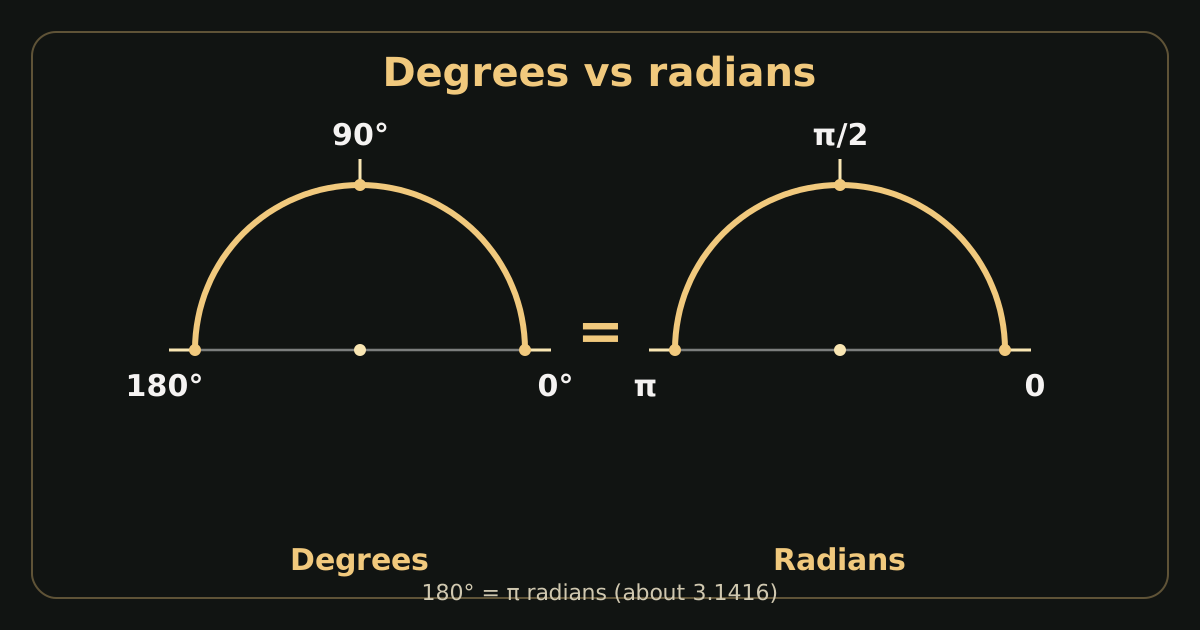
It works because radians, so one degree equals radians.
Example 1: Convert 60 degrees into radians.
- .
- Simplify: .
- radians.
Example 2: Convert 135 degrees into radians.
- .
- Simplify: .
- radians.
These are the angles that appear most often, and they are worth learning by heart.
| Degrees | Radians |
|---|---|
How to Convert Radians into Degrees
Multiply by 180/π, the reverse of the first conversion.
The conversion formula is:
It works because radians , so one radian equals degrees, about .
Example 1: Convert radians into degrees.
- .
- Cancel : .
- .
Example 2: Convert radians into degrees.
- .
- Cancel : .
- .
Some angles have no tidy fraction of , so the answer is a decimal: 1.2 radians is . That is the difference between an exact answer and an approximate one. Keep in the working until the last step, and round only at the end.
How Do Degrees and Radians Affect Arc Length?
The unit picks the formula, and the radian formula is the shorter one.
Arc length using degrees:
It takes the right fraction of the circumference: is of the circle, so the arc is a quarter of .
Arc length using radians:
Here the angle must be in radians. It comes from : multiply both sides by to get . Radians make the formula simpler because a radian already measures the angle in radius lengths.
| Method | Formula | Use it when |
|---|---|---|
| Degrees | The angle is given in degrees | |
| Radians | The angle is given in radians |
Move the slider below and watch both formulas give the same length every time.
Degree Formula
Radian Formula
How to Calculate the Same Arc Length Using Both Methods
Two routes, one answer: 2π, about 6.28 cm.
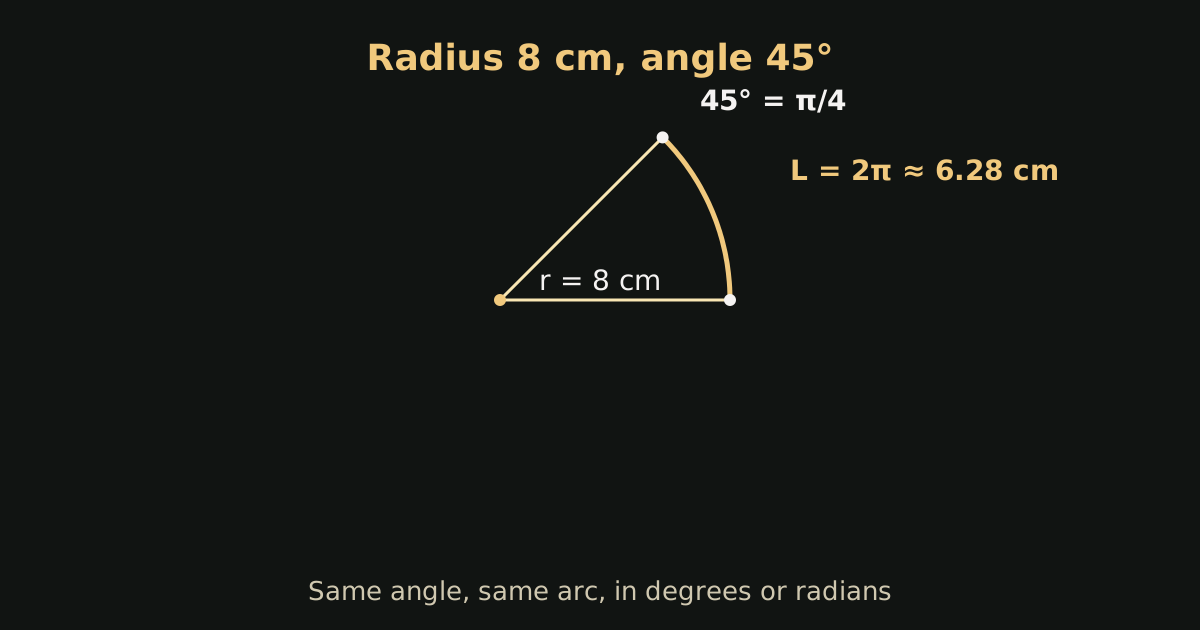
A circle has a radius of 8 cm and a central angle of 45 degrees. Calculate the arc length.
Method 1: Degrees
- .
- Simplify: .
- Circumference: .
- Multiply: cm.
Method 2: Radians
- Convert first: radians.
- .
- Multiply: cm.
Both methods give the same result because and radians are the same angle in different units. Pick the method that matches the unit you were given, and convert only when you need to.
When Should You Use Degrees or Radians?
Use the unit the problem gives you, and convert only when the formula asks for the other.
- Use the degree formula when the angle is in degrees and the problem needs no trigonometry, as in most school geometry problems.
- Use the radian formula when the angle is already in radians: one multiplication, the faster route.
- Convert first when the angle and the formula disagree: degrees going into must become radians first.
- Use radians in advanced mathematics: trigonometry, calculus, and physics all work in radians.
- Use degrees in basic geometry: maps, navigation, and everyday measurement still run on degrees.
In short, check the unit on the angle, pick the formula that matches it, and convert only when a later step needs the other unit.
Calculator Guidance
Mode matters for trig keys, not for plain multiplication.
Most scientific calculators have a degree mode and a radian mode. That setting only changes trigonometric and inverse-trigonometric keys: , , , and their inverses. It does not change ordinary multiplication, so needs a radian angle regardless of mode. If your angle is and you type , the calculator multiplies by 45, not by , and the answer is wrong in either mode. Convert to first, or use the degree formula instead. Check the mode before any problem that uses sine or cosine.
Common Mistakes When Using Degrees and Radians
Seven slips, each with a quick fix.
- Using degrees directly in . An angle of is not 90 radians: with cm, cm is wrong, while cm is right.
- Using the wrong conversion factor. Degrees to radians multiplies by , not . Swapping them turns into about 5,157 radians.
- Confusing 180 degrees with 180 radians. 180 radians is about 10,313 degrees, more than 28 full turns, so always check the unit after the number.
- Forgetting that 360 degrees equals 2π radians. A full circle is radians, not : using for a full turn halves the answer.
- Rounding too early. Keep in the working and round only the final answer.
- Using the wrong calculator mode for trigonometric operations. Sine and cosine answers depend on the mode, so confirm DEG or RAD first.
- Forgetting to label angle measurements. Write for degrees and “rad” for radians: an unlabelled 1.57 could be either.
Practice Problems: Degrees, Radians, and Arc Length
Five questions, then check your work below.
- Convert 90 degrees into radians.
- Convert 150 degrees into radians.
- Convert radians into degrees.
- A circle has a radius of 10 cm and a central angle of 60 degrees. Find its arc length using both formulas.
- A circle has a radius of 5 cm and a central angle of radians. Calculate its arc length.
Answer key:
- radians.
- radians.
- .
- Degrees: cm. Radians: , so cm.
- cm.
Frequently Asked Questions
Short answers.
1. What is the difference between degrees and radians? Both measure the same angle in different units: degrees split a full turn into 360 parts, radians measure it in radius lengths, and a full turn is radians.
2. How many radians are in 360 degrees? radians, about 6.28 radians.
3. How do you convert degrees into radians? Multiply the degrees by . For example, radians.
4. How do you convert radians into degrees? Multiply the radians by . For example, .
5. Why does the arc-length formula use radians? A radian is defined by , which rearranges to the short form . Radians measure the angle in radius lengths, so no 360 is needed.
6. Can you calculate arc length using degrees? Yes: use , which takes the right fraction of the full circumference.
7. What happens if you use degrees in ? The answer comes out far too large: with cm and , cm, while the correct arc is about 15.71 cm. Convert to radians first.
8. Which is easier for calculating arc length? Radians, when the angle is already in radians: is one multiplication. With degrees, use the degree formula and convert only when needed.
9. Is one radian equal to 57.3 degrees? Yes, about : exactly degrees, about .
10. Should a calculator be in degree or radian mode? Match the mode to the angle’s unit, and only for trig keys: for the mode does not matter, since the angle must be in radians either way.
Further Reading
More on the same ideas:
- Maths is Fun: Radians: a plain-English introduction to radians.
- Khan Academy: Introduction to radians: a video lesson on radians and degrees.
- OpenStax Algebra and Trigonometry 2e: Angles: degree and radian measure, with worked examples.
- Wikipedia: Radian: the formal definition of radian measure.