Circle Arc Length Formula: Complete Guide with Examples
Master the Circle Arc Length Formula with our complete guide. Learn the equations for degrees and radians, view 10 solved examples, and try 30 practice problems.
Circle Arc Length Formula: Complete Guide with Examples
Whether you are designing the curved chassis of a new automobile, plotting the trajectory of a spacecraft, or simply trying to pass your next trigonometry exam, circle geometry formulas are an unavoidable part of mathematics. Among the most critical of these is the Circle Arc Length Formula.
What exactly is circle arc length? Why does the formula matter so much to engineers and mathematicians alike? In real-world applications, measuring straight lines is easy—you just use a ruler. But the physical world is rarely perfectly straight. Measuring the exact distance along a curved boundary requires specific algebraic equations.
In this comprehensive guide, you will learn exactly what a circle arc is, what arc length means, and every variation of the arc length formula. By the end of this article, you will know precisely when to use each formula, how to solve complex geometric problems manually, and how to verify your answers using an Arc Length Calculator.
Table of Contents
- What Is Circle Arc Length?
- Parts of a Circle You Must Know
- Circle Arc Length Formula
- Formula Derivation
- How to Calculate Circle Arc Length
- 10 Fully Worked Examples
- Arc Length in Degrees vs Radians
- How to Find Missing Values
- Real World Applications
- Common Mistakes
- Circle Arc Length vs Chord Length
- Circle Arc Length Practice Problems
- Practice Problem Solutions
- Frequently Asked Questions
- How an Arc Length Calculator Works
- Summary
What Is Circle Arc Length?
To understand the Circle Arc Length Formula, we first need to define the underlying concepts.
Definition
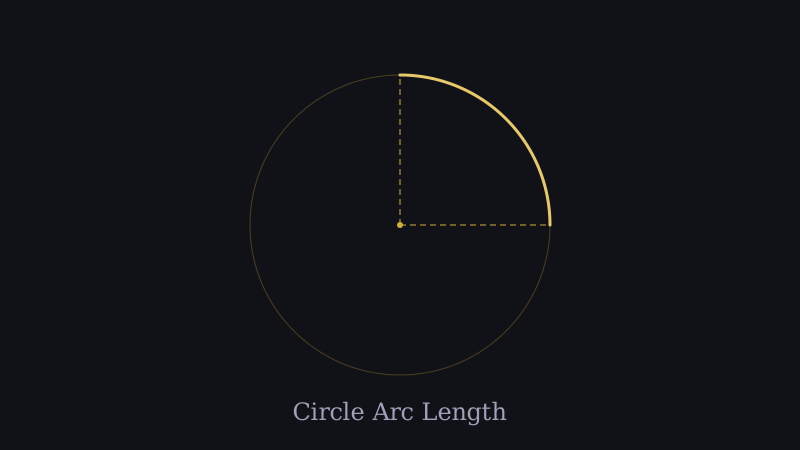
A circle arc is simply a continuous segment or portion of the boundary (perimeter) of a circle. Therefore, circle arc length is the physical distance along that curved segment. Imagine wrapping a flexible tape measure around the edge of a curved surface; the number you read off the tape is the arc length.
Difference Between Circumference and Arc Length
The circumference is the total distance around the entire closed loop of the circle. The arc length is merely a fraction of that total distance. If the circumference is the whole pie, the arc length is the crust on just one slice.
Difference Between Arc and Chord
An arc and a chord both connect two specific points on a circle. However, an arc takes the long way around, following the exact curvature of the circle’s edge. A chord takes the shortest path—a straight line—cutting directly through the circle’s interior. Because the shortest path between two points is a straight line, arc length is mathematically guaranteed to be longer than chord length.
Minor Arc vs Major Arc vs Semicircle
When you choose two points on a circle, you actually create two different arcs:
- Minor Arc: The shorter path between the two points. It corresponds to a central angle of less than 180°.
- Major Arc: The longer path around the remainder of the circle. It corresponds to a central angle of greater than 180°.
- Semicircle: When the two points sit exactly on opposite ends of a diameter, the circle is split into two equal arcs. Both are semicircles with an angle of exactly 180°.
Parts of a Circle You Must Know
Before applying the Circle Arc Length Formula, you must be intimately familiar with the anatomy of a circle.
- Center: The exact middle point of the circle. Every single point on the outer boundary is exactly the same distance from this center.
- Radius (): The distance from the center to any point on the circle’s edge. It is the most critical variable in circle geometry formulas.
- Diameter (): A straight line that passes straight through the center, touching the circle at two opposite points. It is exactly twice the length of the radius ().
- Circumference (): The total perimeter or boundary of the circle ().
- Central Angle (): An angle whose vertex is at the center of the circle. Its legs extend outward to intersect the circle, defining the arc.
- Arc ( or ): The curved portion of the perimeter defined by the central angle.
- Sector: The area enclosed by two radii and the arc. It looks like a slice of pizza.
- Chord: A straight line segment whose endpoints lie anywhere on the circle.
- Tangent: A straight line outside the circle that touches the circle at exactly one single point, never crossing the interior.
Comparison Table: Circle Terminology
| Term | Symbol | Measurement Type | Relationship / Formula |
|---|---|---|---|
| Radius | Straight Length | ||
| Diameter | Straight Length | ||
| Circumference | Curved Length | or | |
| Central Angle | Angle (Degrees/Radians) | (in radians) | |
| Arc Length | Curved Length | (in radians) | |
| Sector Area | Area (Square Units) | (in radians) |
Circle Arc Length Formula
The Variables
There is more than one way to write the arc length equation, depending entirely on how you choose to measure your central angle.
Radians Formula
When your angle is measured in radians, the formula is remarkably elegant:
Where:
- = Arc length
- = Radius of the circle
- = Central angle (must be in radians)
This is the preferred formula in calculus, engineering calculations, and higher mathematics because it avoids arbitrary constants.
Degrees Formula
In everyday geometry, degrees are more common. Because there are 360 degrees in a full circle, the formula requires a conversion factor:
This simplifies gracefully to:
Where:
- = Arc length
- = Radius of the circle
- = Central angle in degrees
- = Pi ()
Fraction of Circumference Formula
If you do not know the radius, but you already know the total circumference (), you can calculate arc length using basic proportions:
Why do all three formulas produce the same answer? They are fundamentally identical! The expression is simply the formula for the circumference. In the degrees formula, multiplying the total circumference by the fraction of the circle () gives you the fraction of the perimeter—which is the arc length. Because degrees equals radians, replacing with and with algebraically reduces the equation back to .
Formula Derivation
Understanding where the Circle Arc Length Formula comes from ensures you won’t forget it during an exam. Let’s derive it step by step from the fundamental concept of circumference.
Step 1: Start with the total circumference. We know the formula for the entire perimeter of a circle is .
Step 2: Understand the geometry of a full circle. A complete circle contains degrees. Therefore, the distance of an arc that covers degrees is exactly equal to .
Step 3: Create a mathematical proportion. If an arc length corresponds to a central angle , and the total circumference corresponds to , their ratios must be equal:
Step 4: Solve for . Multiply both sides of the equation by :
Step 5: Derive the Radian Formula. To convert this to radians, we use the fact that is exactly equal to radians. Let’s replace with in our formula:
Step 6: Simplify the algebra. The in the numerator and the in the denominator perfectly cancel each other out:
By explicitly deriving the equation, you can see that the Circle Arc Length Formula is merely a logical extension of calculating a proportional slice of a circle’s perimeter.
How to Calculate Circle Arc Length
Follow this foolproof, five-step process to ensure you correctly calculate arc length every single time.
Step 1: Identify the Radius
Find the radius (). If a problem gives you the diameter (), divide it by immediately to avoid the most common geometry mistake.
Step 2: Find the Central Angle
Identify your angle (). Note whether the problem gives the angle in degrees or radians. This unit determines your next step.
Step 3: Convert Degrees if Needed
If your angle is in degrees, but you prefer the simple formula, you must convert it. Multiply your degree value by to get radians. Alternatively, simply use the degree formula.
Step 4: Apply the Formula
Plug the radius and angle into your chosen formula:
- Radians:
- Degrees:
Step 5: Check Units
Look at the units provided for the radius (inches, meters, miles). Your final arc length will be in that exact same linear unit. If the radius is in centimeters, the arc length is in centimeters.
10 Fully Worked Examples
Image Suggestion: A hand-drawn style illustration showing a circle with a highlighted 60 degree sector and calculated arc length. Alt text: “A step by step mathematical calculation of arc length on a notebook.”
The best way to master how to calculate arc length is through practice. Here are 10 fully solved examples covering a wide variety of scenarios.
Example 1: Calculating 30° Arc Length
Problem: Find the arc length of a circle with a radius of cm and a central angle of . Solution:
- Radius
- Angle
- Formula:
- Answer: cm
Example 2: Calculating 45° Arc Length
Problem: A pizza has a diameter of inches. What is the arc length of the crust on a slice? Solution:
- The diameter is , so the radius
- Angle
- Formula:
- Answer: inches
Example 3: Calculating 60° Arc Length
Problem: Given meters and , find . Solution:
- Radius
- Angle
- Formula:
- Answer: meters
Example 4: Calculating 90° Arc Length
Problem: A runner runs exactly one-quarter of a circular track (). The radius is yards. How far did they run? Solution:
- Radius
- Angle
- Formula:
- Answer: yards
Example 5: Calculating 120° Arc Length
Problem: Radius mm, Angle . Find the arc length. Solution:
- Formula:
- reduces to .
- Answer: mm
Example 6: Calculating 135° Arc Length
Problem: Radius feet, Angle . Solution:
- Formula:
- reduces to .
- Answer: feet
Example 7: Calculating a 180° Semicircle
Problem: Find the perimeter of a semicircular archway with a diameter of feet (only the curved part). Solution:
- Diameter is , so .
- A semicircle is .
- Formula:
- Answer: feet
Example 8: Calculating 240° (Major Arc)
Problem: Radius cm, Angle . Solution:
- Formula:
- reduces to .
- Answer: cm
Example 9: Calculating with Radians
Problem: Radius inches, Angle radians. Solution:
- Angle is in radians, so use .
- Answer: inches
Example 10: Calculating with Decimal Values
Problem: Radius cm, Angle . Solution:
- Formula:
- Fraction:
- Answer: cm
Arc Length in Degrees vs Radians
Degree Formula
Radian Formula
The choice between degrees and radians isn’t just a matter of preference; it changes the core mathematics of your equation.
Conversion Formulas
If you need to switch between the two systems, use these conversion factors:
- Degrees to Radians:
- Radians to Degrees:
Comparison Table: Degrees vs Radians
| Feature | Degrees | Radians |
|---|---|---|
| Origin | Babylonian astronomy | Pure geometric ratios |
| Full Circle | ||
| Formula Used | ||
| Best Used For | Navigation, surveying, basic schooling | Calculus, physics, programming |
Common Mistakes When Switching
The most catastrophic error students make is plugging a degree value into the radian formula. If your radius is and your angle is , calculating is entirely wrong. The correct answer is . Always verify your units!
How to Find Missing Values
Often, real-world problems don’t ask you for the arc length. Instead, they give you the arc length and ask you to work backward to find the radius or the angle. The Circle Arc Length Formula is easily algebraic.
Finding Radius from Arc Length
If you know and (in radians), finding is simple division:
Example: Arc length is , angle is radians. Solution: .
Finding Angle from Arc Length
If you know and , the angle in radians is:
Example: Arc length is , radius is . Solution: radians.
Finding Circumference from Arc Length
If an arc length of represents a slice (which is exactly one-quarter of the circle), the total circumference must be times the arc length: Example: .
Finding Sector Area from Arc Length
If you know the arc length () and the radius (), you can find the area of the pie slice (sector) without even knowing the angle! The formula is: Example: Arc length is , radius is . Solution: Area = square units. Need more help? Try our Sector Area Calculator.
Real World Applications
Image Suggestion: A blueprint graphic of a curved suspension bridge or roller coaster. Alt text: “An engineering diagram showing the application of arc length in civil engineering and architecture.”
The Circle Arc Length Formula is not just textbook trivia; it builds the modern world. Here are just a few fields that rely on these engineering calculations daily.
Architecture
Architects utilize the formula when designing curved walls, domes, and arched doorways. If an architect is designing a curved glass facade, they must calculate the exact arc length to order the correct width of the glass panels.
Road Engineering & Civil Engineering
When road engineers design highway interchanges or off-ramps, they design them as arcs of circles. Calculating the arc length tells them exactly how many miles of asphalt to pour, how to bank the curve for safety, and how long the speed-reduction zone must be.
Mechanical Engineering
Gears, pulleys, and timing belts operate entirely on circle geometry formulas. When a motor turns a -inch radius wheel by , the engineer uses the arc length formula to calculate precisely how many inches the attached conveyor belt will move.
Manufacturing
In CNC machining and manufacturing, cutting tools frequently follow circular paths. The software must calculate the arc length of the cut to determine how long the cut will take at a specific speed, which dictates the manufacturing cost.
Aviation
Airplanes fly across the curved surface of the Earth. Navigational computers calculate “great-circle distances,” which are literal arc length calculations based on the Earth’s radius, to find the fastest flight paths.
Astronomy
Astronomers measuring the path of a comet or the orbit of a satellite rely on arc length to predict how far an object travels through space over a given period of time.
Robotics
When a robotic arm with a specific length (radius) pivots from its base by a certain angle, the distance its claw travels through the air is calculated via the arc length equation.
Graphic Design
Digital graphic designers and software engineers rendering vector graphics use arc length algorithms to ensure smooth curves and accurate stroke dashing when creating logos and user interfaces.
Common Mistakes
[!WARNING] Warning: Using Diameter Instead of Radius The most frequent error in geometry tests is forgetting to halve the diameter. If a problem states “A circle with a diameter of 12”, using in your formula will instantly double your answer and make it wrong. must be .
Here are other critical mistakes to watch out for:
- Forgetting Radians: Blindly multiplying when is in degrees. You must use the degree formula or convert first.
- Wrong Calculator Mode: When checking answers with trigonometric functions, having your calculator in DEG mode when doing RAD math will yield bizarre results.
- Mixing Units: If your radius is in inches but your final required answer is in feet, do not forget your final conversion step.
- Rounding Too Early: If you calculate as in step 1, your final answer might be off by several decimals. Always keep in your equation until the very last step.
Circle Arc Length vs Chord Length
While the arc length is the curved path, the chord length is the straight line connecting the same two points.
Comparison Table: Arc vs Chord
| Feature | Circle Arc Length () | Chord Length () |
|---|---|---|
| Formula (Radians) | ||
| Shape | Perfectly curved with the circle | Perfectly straight line |
| Measurement | Always larger than the chord | Always shorter than the arc |
| Maximum Limit | Infinite (can loop infinitely) | Equal to the diameter () |
| Applications | Roads, perimeters, wheel rotations | Support beams, bridge ties, cross-sections |
| Accuracy Needs | Requires for precision | Requires trigonometry (sine) for precision |
Check out our Chord Length Calculator for direct comparisons.
Circle Arc Length Practice Problems
Image Suggestion: An illustrated blackboard containing geometry math problems. Alt text: “A chalkboard with 30 practice problems for calculating arc length.”
Test your newly acquired knowledge with these 30 practice questions. Try to solve them manually before checking the solutions.
10 Beginner Questions
- Find arc length: , radians.
- Find arc length: , .
- Find arc length: , radians.
- Find arc length: , .
- Find arc length: diameter , radian.
- Find arc length: , radians.
- Find arc length: , .
- Find arc length: , .
- Find arc length: diameter , .
- Find arc length: , .
10 Intermediate Questions
- An arc length is and radius is . Find in radians.
- An arc length is and . Find the radius.
- A arc is inches long. Find the radius.
- A circle has a circumference of . Find the arc length of a sector.
- Convert to radians, then find arc length if .
- Find arc length: , radians.
- Find the major arc length if the minor arc angle is and .
- A pendulum meters long swings . How far does the tip travel?
- Find the perimeter of a sector with and .
- Find arc length: , radians.
10 Advanced Questions
- A wheel of radius inches rolls forward feet. Through what angle (in degrees) did it rotate?
- The Earth has a radius of miles. What is the arc length between two cities on the equator separated by of longitude?
- A gear with cm rotates at RPM. What arc length does a point on the edge travel in seconds?
- A arc on Circle A is equal in length to a arc on Circle B. What is the ratio of their radii?
- Find the arc length if the chord length is and the radius is . (Hint: Determine the angle first based on the triangle formed).
- Find the area of a sector if the arc length is and radius is .
- A satellite orbits miles above Earth’s surface ( miles) sweeping a arc. How far did it travel?
- An arc measures cm. If the radius is doubled and the angle is halved, what is the new arc length?
- A windshield wiper is inches long but is mounted on a -inch arm (total radius = ). If it sweeps , what is the arc length of the outer edge vs the inner edge?
- Prove that the arc length of a semicircle is exactly .
Practice Problem Solutions
Beginner Solutions
- Radius is .
- Radius is .
Intermediate Solutions
- radians
- .
- formula.
- .
- Major angle .
- meters
- Arc . Perimeter
Advanced Solutions
- feet inches. radians. Degrees
- miles
- RPM rev/sec. In seconds revs. Angle rad. cm
- If and chord, the triangle is equilateral. Thus .
- Area
- Total . miles
- . The length is unchanged: cm
- Outer . Outer Arc . Inner . Inner Arc inches.
- The full circumference formula is . A semicircle is precisely half a circle. . Q.E.D.
Frequently Asked Questions
1. What is circle arc length? Circle arc length is the physical, curved distance measured along the perimeter (circumference) of a circle between two specified points.
2. What is the easiest formula? The absolute easiest formula is the radian formula: . You simply multiply the radius by the angle, avoiding complex fractions.
3. Why are radians preferred? Radians are mathematically pure. They represent a ratio of arc length to radius, making them “dimensionless.” This allows them to interface cleanly with advanced calculus without arbitrary conversion factors like or .
4. Can arc length exceed circumference? Yes. If an object (like a wheel) rotates more than , the accumulated arc length traveled is larger than a single circumference of the wheel.
5. Is arc length measured in degrees? No. This is a common misconception. The central angle is measured in degrees, but the arc length is a linear distance measured in units like meters, feet, or inches.
6. How is arc length used in engineering? Civil engineers use it to calculate the exact length of curved highway segments. Mechanical engineers use it to determine the travel distance of belts on pulleys and gears.
7. Can arc length be negative? In physical geometry, a length is an absolute distance and cannot be negative. In advanced vector calculus, an arc length integral might have a directional sign, but for basic circle formulas, it is always positive.
8. Does every circle use the same formula? Yes! The beauty of circle geometry is that the Circle Arc Length Formula applies universally to all perfect circles, regardless of their size, from atoms to galaxies.
9. How do I find the arc length without the radius? You cannot find it without the radius unless you have the total circumference or the diameter, from which you can easily derive the radius ( or ).
10. What is a minor arc? A minor arc is the shortest path between two points on a circle, corresponding to a central angle of less than .
11. What is a major arc? A major arc is the longest path around the circle between two points, corresponding to a central angle of greater than .
12. How do you find the arc length of a semicircle? Multiply the radius by . The formula is the shortcut for a semicircle.
13. What happens if I double the radius? Because the formula () is linear, doubling the radius will exactly double the arc length, assuming the angle stays the same.
14. What happens if I halve the central angle? Halving the central angle will exactly halve the arc length, assuming the radius remains constant.
15. How does arc length differ from a chord? An arc follows the curved edge of the circle. A chord is a straight line drawn directly across the circle’s interior between the same two endpoints.
16. Is arc length proportional to the sector area? Yes. As the arc length increases, the area of the pie-shaped sector it encloses increases proportionally. The formula is .
17. What is a subtended angle? “Subtended” simply means the angle created at the center of the circle by drawing lines from the two ends of the arc.
18. What if my angle is given in minutes or seconds? You must convert minutes and seconds into decimal degrees before plugging them into the degree formula. (Divide minutes by , and seconds by ).
19. Why is Pi () used in the formula? Pi is the fundamental ratio of a circle’s circumference to its diameter. Since arc length is a fraction of the circumference, naturally appears in the calculation.
20. Can I calculate the arc length of an oval (ellipse)? Not with this simple formula. Ellipses have continuously changing radii, meaning their arc lengths require highly complex elliptic integrals to solve.
21. What is the formula for arc length from circumference? If you only have circumference () and the angle in degrees, use .
22. How do you find the angle if you know the arc length? Rearrange the formula: .
23. How do you find the radius if you know the arc length? Rearrange the formula: .
24. Do I need a scientific calculator to find arc length? You only need a basic calculator to multiply radius by angle and by . However, a scientific calculator is helpful for retaining the precise value of .
25. Can I use an online arc length calculator instead? Absolutely. Online calculators prevent basic arithmetic and conversion errors, saving you time and ensuring perfect accuracy.
How an Arc Length Calculator Works
Image Suggestion: A screenshot or stylized illustration of an online arc length calculator interface. Alt text: “The user interface of an online arc length calculator.”
While it is crucial to understand the manual calculations outlined in this guide, executing them repeatedly by hand is prone to human error—especially when dealing with the endless decimals of or converting between degrees and radians.
This is exactly why professionals and students rely on our Arc Length Calculator.
Our calculator streamlines the process by combining all formulas into one intuitive tool:
- Inputs: You simply enter your radius and your angle.
- Formula selection: The calculator automatically detects whether you selected degrees or radians from the dropdown menu and applies the correct mathematical formula instantly.
- Step by step calculations: It doesn’t just spit out a number. It shows you the exact formula used and the step-by-step reduction, making it an incredible study aid.
- Error reduction: It entirely eliminates the risk of calculator mode errors, dropping a decimal, or forgetting to multiply by .
For complex engineering calculations, or to quickly verify your geometry homework, our tool is indispensable. You can also explore our Circumference Calculator, Sector Area Calculator, and Radius Calculator for comprehensive circle geometry assistance.
Summary
Mastering the Circle Arc Length Formula empowers you to solve complex, real-world problems involving curves and trajectories. Here are the key takeaways from this complete guide:
- Arc Length Definition: The literal curved distance along the edge of a circle.
- Know Your Units: Before doing any math, verify if your central angle is measured in radians or degrees.
- Radian Formula: The simplest equation is .
- Degree Formula: You must incorporate and , resulting in .
- Diameter Trap: Always ensure you are plugging the radius into the equation. If given a diameter, divide it by first!
- Arc vs Chord: An arc is curved and longer; a chord is straight and shorter.
Whether you are calculating the sweep of a windshield wiper, the stagger of a running track, or the orbit of a satellite, the formulas detailed above remain exactly the same. Bookmark this guide for your future geometry needs, and never hesitate to double-check your manual arithmetic using our dedicated suite of circle calculators.
For further academic reading, we recommend exploring geometry resources from Khan Academy and the MIT OpenCourseWare.